
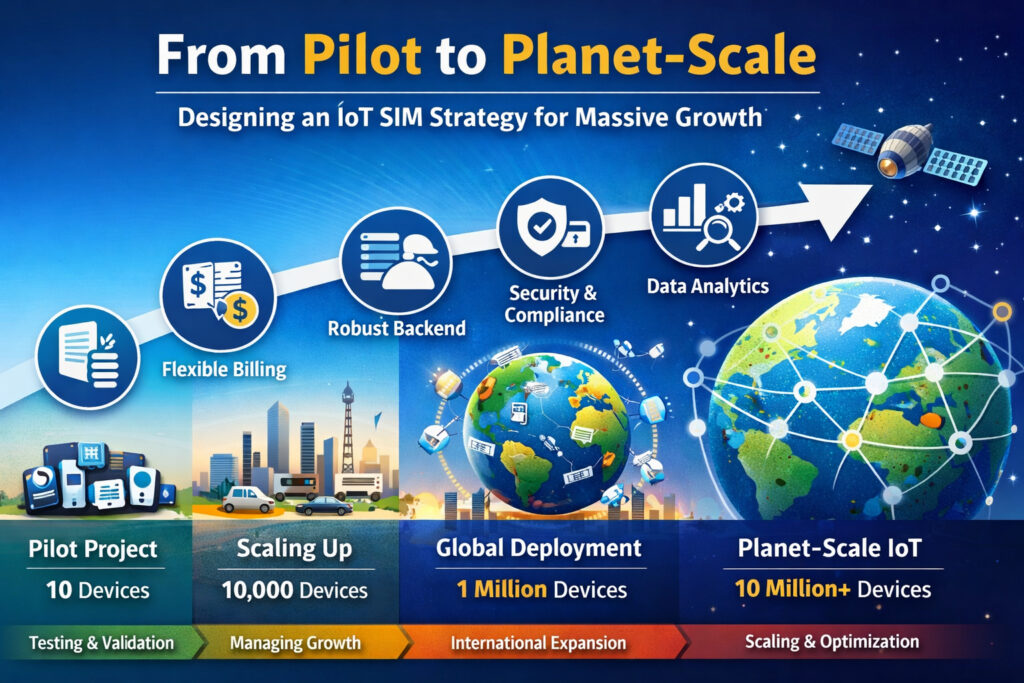
Launching an IoT project often begins with a spark: a handful of sensors in a warehouse, a few smart meters in a neighborhood, or a prototype tracker riding along in the back of a delivery van. The pilot phase feels intimate and manageable. Data flows, dashboards glow, and success seems just a firmware update away. But when that spark catches and the project grows from dozens of devices to thousands, then millions, connectivity stops being a background detail and becomes the nervous system of your entire operation.
This is where many promising IoT deployments stumble. The same SIM strategy that worked beautifully for ten devices can collapse under the weight of global scale. Networks behave differently across borders, billing becomes a maze of currencies and contracts, and managing millions of active endpoints can feel like herding digital constellations across the sky.
Designing an IoT SIM strategy with planet-scale ambition from day one is not about overengineering. It is about building a flexible foundation that grows as your deployment grows, without forcing painful migrations or costly rewrites along the way.
The Pilot Phase: Where Assumptions Are Born
In the early days, speed usually wins. Teams grab a handful of SIM cards, plug them into devices, and get the proof of concept running. Coverage looks fine, data costs seem reasonable, and the portal dashboard feels like a cockpit for the future. But pilots often create hidden assumptions that do not survive scale.
At ten devices, it does not matter if a SIM only works well in one country. At ten million, regional coverage gaps can turn into entire dark continents on your network map. At pilot scale, a simple spreadsheet can track usage. At global scale, billing and analytics require automation, APIs, and real-time alerts.
The key question to ask during the pilot is not “Does this work?” but “Will this still work when everything changes?”
Coverage Without Borders
One of the first scaling challenges is geography. Many IoT projects begin in a single region, often near headquarters or a primary market. When expansion starts, devices suddenly appear in new regulatory environments, new radio landscapes, and new carrier ecosystems.
A planet-scale SIM strategy relies on multi-network access rather than a single carrier relationship. This means your devices can connect to the strongest available network in each country, rather than being locked into a roaming agreement that may not perform well everywhere. Multi-IMSI or profile-based SIMs allow devices to adapt as they move or as local networks change over time.
Think of your connectivity like a passport instead of a visa. A visa lets you enter one country. A passport lets you keep traveling when the journey evolves.
Building for Network Intelligence
At small scale, a dropped connection is an inconvenience. At global scale, it can become a systemic failure. Network intelligence is what separates resilient IoT deployments from fragile ones.
Modern IoT SIM platforms provide features like automatic failover, signal quality monitoring, and network performance analytics. These tools allow you to see not just where your devices are, but how well they are communicating. Over time, this data becomes a strategic asset. You can identify underperforming regions, predict outages, and even optimize antenna design based on real-world signal behavior.
Scaling is not just about adding more devices. It is about teaching your network to learn from itself.
Security as a Growth Enabler
Security is often treated as a gate at the end of the road, something to pass before going live. At planet scale, security becomes the road itself.
As your deployment grows, your attack surface grows with it. Public internet access for millions of devices can expose sensitive data and critical infrastructure to unnecessary risk. This is where private APNs, VPN tunnels, and network-level firewalls built into your SIM strategy become essential.
By routing device traffic through a controlled, private network path, you reduce exposure and simplify compliance with regulations like GDPR, HIPAA, or industry-specific standards. Instead of bolting security onto each device individually, you bake it into the connectivity layer itself.
In a global deployment, the SIM is not just a key. It is the lock, the door, and the hallway behind it.
Data Economics at Scale
The difference between a good and a great IoT SIM strategy often shows up on the invoice. At small scale, data costs feel predictable. At large scale, even small inefficiencies can multiply into major budget line items.
Pooled data plans are one way to smooth out usage variability across thousands of devices. Instead of each SIM having its own strict limit, the entire deployment shares a common pool of data. High-usage devices balance out low-usage ones, creating a more efficient and predictable cost structure.
Real-time usage monitoring and automated alerts also become critical. When a device suddenly spikes in data consumption, it can indicate a malfunction, a security issue, or a firmware loop. Catching that early saves both money and operational headaches.
At planet scale, every megabyte tells a story. The trick is learning how to read it.
The Single Pane of Glass
Managing ten devices can be done with a list. Managing ten million requires a command center.
A centralized SIM management portal becomes the heart of a global IoT operation. From one interface, teams should be able to activate, suspend, or reassign SIMs, monitor connectivity status, view usage trends, and integrate data into their own systems through APIs.
This “single pane of glass” approach reduces complexity across departments. Operations teams see device health. Finance teams see cost trends. Developers see integration points. Executives see growth in motion.
The portal is not just a tool. It is the shared language of your entire IoT organization.
Designing for Motion and Change
Many IoT deployments do not stay in one place. Fleets cross borders, containers move across oceans, and devices are redeployed from one market to another as business priorities shift.
A scalable SIM strategy treats movement as a feature, not a problem. This means supporting seamless roaming, fast network handovers, and compliance with local regulations around permanent roaming or data residency.
It also means planning for technology shifts. The networks of today will not be the networks of tomorrow. LTE-M, NB-IoT, and 5G are all evolving, and future standards will follow. eSIM and iSIM technologies allow connectivity profiles to be updated over the air, extending the life of hardware and protecting your investment as the connectivity landscape changes.
Choosing a Partner, Not Just a Provider
At pilot scale, any SIM that works can feel like the right choice. At planet scale, the relationship matters as much as the technology.
A true IoT connectivity partner offers more than coverage maps and price sheets. They provide onboarding support, API documentation, integration guidance, and a roadmap that aligns with your own growth plans. They understand the regulatory, technical, and operational challenges of scaling across continents and industries.
The difference shows up when something goes wrong, or when something goes bigger than expected.
From Experiment to Ecosystem
The journey from ten devices to ten million is not just a technical transformation. It is an organizational one. Connectivity touches product design, customer experience, finance, compliance, and strategy.
By treating your IoT SIM strategy as a core part of your architecture, rather than an afterthought, you create a platform that can support innovation instead of slowing it down. New markets become opportunities instead of obstacles. New use cases become extensions instead of exceptions.
Planet-scale IoT is not about building the biggest network. It is about building the most adaptable one.
The Final Signal
Every global IoT success story begins the same way: with a small pilot and a bold idea. What separates the stories that fade from the ones that reshape industries is the foundation beneath them.
Design your SIM strategy like you expect to succeed. Build for borders you have not crossed yet, regulations you have not met yet, and networks that have not been turned on yet.
When your connectivity is ready for the whole planet, your ideas can be too.