
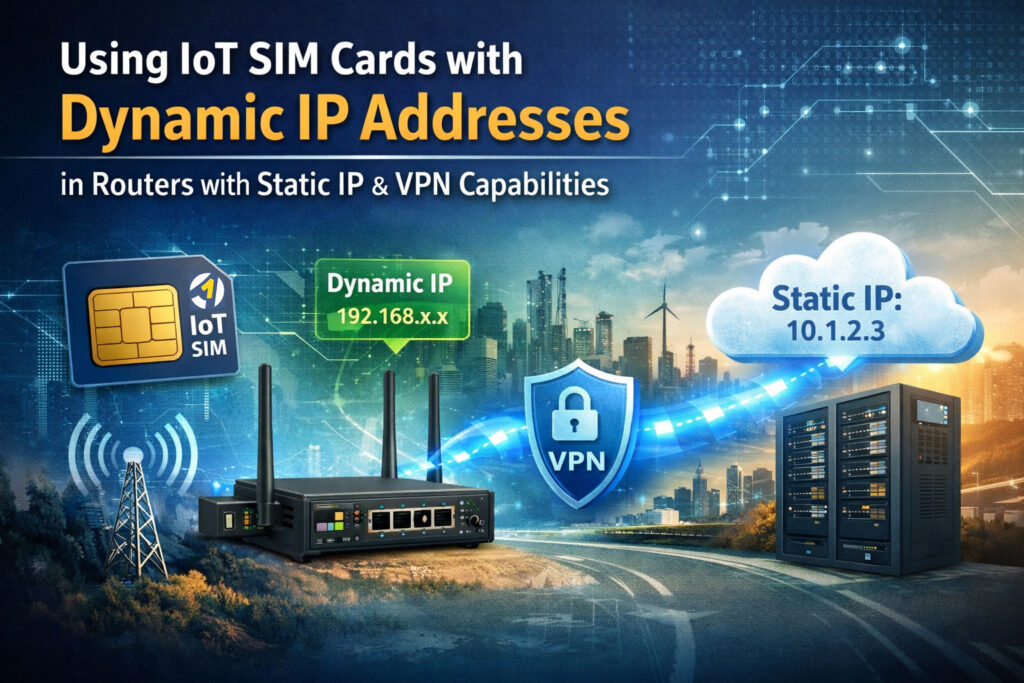
As IoT deployments continue to scale across industries, reliable and secure connectivity becomes just as critical as the devices themselves. From industrial controllers and smart meters to mobile routers in vehicles and remote monitoring systems, many IoT deployments rely on cellular routers powered by IoT SIM cards.
One common question arises early in the design phase:
How can devices using IoT SIM cards with dynamic IP addresses still achieve secure, stable, and manageable connectivity?
The answer lies in combining dynamic IP IoT SIMs with routers that support static IP mapping and VPN tunnels. This architecture offers flexibility, security, and scalability without the cost or complexity of provisioning static IPs on every SIM.
This article explains how dynamic IP IoT SIMs work, why they are commonly used, and how modern routers overcome their limitations using static IP and VPN technologies.
Understanding Dynamic IP Addresses in IoT SIM Cards
Most IoT SIM cards use dynamic private IP addresses by default. When a device connects to a mobile network, the carrier assigns it a temporary IP address, often behind carrier-grade NAT (CGNAT). This IP can change:
- When the device reconnects
- When it roams between networks
- When sessions time out
- When the carrier reassigns network resources
Dynamic IP addressing is widely used because it:
- Conserves IPv4 address space
- Reduces carrier costs
- Improves scalability for large deployments
- Simplifies SIM provisioning across regions
For outbound-only communication, such as sending telemetry data to the cloud, dynamic IP addresses pose little issue. Problems arise when inbound access, remote management, or persistent connections are required.
The Challenge: Inbound Access and Remote Management
IoT deployments often require:
- Remote access to routers or devices
- Secure device-to-cloud communication
- Centralized monitoring and configuration
- Predictable network endpoints
- Compliance with security policies
With a dynamic IP and CGNAT, the device cannot be directly addressed from the public internet. This makes tasks such as remote diagnostics, firmware updates, or device control more complex.
Rather than assigning static public IPs to every SIM, which can be costly and limited in availability, most modern IoT architectures solve this at the router and network layer.
Routers with Static IP and VPN Capabilities
Industrial and IoT-grade cellular routers are designed specifically to work with dynamic IP SIMs. These routers support advanced networking features that effectively “neutralize” the limitations of dynamic IP addressing.
Key features include:
- VPN client and server support
- Persistent outbound tunnels
- Static routing within private networks
- Secure authentication and encryption
- Integration with cloud platforms
By establishing an outbound VPN tunnel, the router creates a stable and secure virtual connection to a central server or cloud gateway, regardless of the SIM’s dynamic IP.
How VPNs Enable Static Connectivity over Dynamic IPs
The most common solution is an outbound-initiated VPN tunnel.
Here’s how it works:
- The router connects to the cellular network using a dynamic IP IoT SIM.
- The router initiates a VPN connection to a fixed endpoint (cloud server, data center, or corporate firewall).
- The VPN tunnel remains persistent, even if the SIM’s IP changes.
- All inbound and outbound traffic flows securely through the tunnel.
- The device appears as if it has a static, reachable address within the private VPN network.
Because the connection is outbound-initiated, it works seamlessly through CGNAT and across multiple mobile carriers.
Common VPN Technologies Used in IoT Routers
Modern IoT routers support several VPN protocols, each with different advantages:
IPsec VPN
- Highly secure and widely supported
- Common in enterprise and industrial environments
- Ideal for site-to-site connectivity
OpenVPN
- Flexible and firewall-friendly
- Strong encryption
- Easy to deploy across mixed environments
WireGuard
- Lightweight and fast
- Excellent performance on constrained devices
- Increasingly popular in modern IoT deployments
GRE or L2TP (with encryption)
- Useful for specific routing scenarios
- Often combined with IPsec for security
The choice depends on security requirements, performance needs, and network architecture.
Static IP Mapping Inside the VPN
Once the VPN tunnel is established, the router and connected devices can be assigned static private IP addresses within the VPN.
This allows:
- Consistent device addressing
- Centralized firewall rules
- Predictable routing
- Easy integration with SCADA, cloud platforms, or enterprise systems
From the perspective of your application or management platform, the device always appears at the same IP address, even though the underlying cellular IP is dynamic and changing.
Benefits of Dynamic IP IoT SIMs with VPN-Enabled Routers
This architecture delivers several important advantages:
Cost Efficiency
Dynamic IP SIMs are more affordable and widely available than static IP SIMs, especially for global deployments.
Scalability
Easily scale to thousands or millions of devices without exhausting static IP resources.
Security
VPN encryption protects data in transit and isolates devices from the public internet.
Global Flexibility
Works seamlessly across multiple carriers, regions, and roaming scenarios.
Resilience
If the cellular network changes IPs or switches carriers, the VPN automatically re-establishes.
Real-World Use Cases
Industrial Automation
PLCs and controllers connect securely to centralized monitoring systems without exposing devices to the public internet.
Smart Infrastructure
Traffic systems, utilities, and smart meters use VPN tunnels for secure data collection and control.
Transportation and Fleet
Mobile routers in vehicles maintain persistent connectivity back to headquarters while roaming across regions.
Retail and Digital Signage
Remote management of displays and POS systems using private VPN addressing.
Energy and Utilities
Substations, solar farms, and wind turbines connect securely over cellular without static IP overhead.
When Is a Static IP IoT SIM Still Needed?
While VPN-based architectures cover most scenarios, static IP SIMs may still be required when:
- Direct inbound connections are mandatory without VPN
- Legacy systems cannot support VPNs
- Regulatory requirements demand fixed public IPs
- Third-party platforms require whitelisted IP addresses
Even in these cases, many organizations use hybrid models, reserving static IP SIMs for special endpoints while using dynamic IP SIMs with VPNs for the majority of devices.
Best Practices for Deployment
- Choose IoT SIMs that support multi-network roaming for resilience
- Use routers designed for industrial or IoT environments
- Implement strong authentication and key management for VPNs
- Monitor tunnel health and reconnect logic
- Segment networks using VLANs or private subnets
- Plan for over-the-air updates and remote diagnostics
Best Routers for Field IoT Sites with Dynamic IoT SIMs and Cloud VPN
Deploying IoT solutions in the field — whether that’s oil & gas sites, utility substations, remote signage, transportation hubs, or agricultural stations — throws a unique set of networking challenges at you:
- Cellular connectivity with dynamic IP SIMs (no static public IP)
- Secure, persistent remote access
- Hard-to-reach physical locations
- Harsh environments and uptime expectations
- Remote management without local IT support
The best way to satisfy all these needs is a field-ready cellular router that supports:
✔ native VPN client capabilities (IPsec, OpenVPN, WireGuard)
✔ Cloud management dashboards (for remote monitoring)
✔ Cellular uplinks via LTE/5G from IoT SIM cards
✔ Auto VPN reconnection even if the SIM IP changes
Below are excellent router choices rated specifically for field deployments and cloud/VPN readiness.
🛠️ 1. Peplink Balance and MAX Series
Best for rugged field sites with multi-WAN and advanced VPN features
Why they’re field winners:
🔹 Peplink MAX BR1 Mini LTE Router – Rugged cellular router with strong VPN support (SpeedFusion). Great for single-site field IoT with fallback to multiple carriers.
🔹 Peplink Balance One – Desktop/edge unit if you have bigger LAN sites with wired + cellular redundancy.
🔹 Peplink MAX HD2 IP55 – Weather-resistant industrial unit (IP55) built for outdoor cabinets, substations, and long-term field installs.
🔹 Peplink Transit Duo LTE Router – Dual cellular for carrier redundancy, strong VPN failover, excellent in transportation or mobile field use.
Key strengths:
- Peplink’s SpeedFusion VPN for resilient encrypted tunnels that auto-heal when IP changes.
- Centralized cloud management via InControl2.
- Excellent field reliability and failover logic.
Good fit for: solar farms, remote utilities, public safety, ITS (intelligent transportation systems).
🚀 2. Sierra Wireless AirLink Routers
Enterprise-grade cellular with robust VPN and remote management
Why field engineers love them:
🔹 AirLink LX60 – Compact yet rugged, ideal for simple field sites.
🔹 AirLink MP70 – Premium 5G/4G multi-carrier support, advanced VPN options.
🔹 AirLink ES4400 – Highly modular and IoT-optimized with exceptional security features.
Key strengths:
- Built-for purpose cellular with carrier agnostic VPN support
- AirLink Management Service (ALMS) and AirVantage cloud dashboards
- Excellent remote diagnostics and scripting APIs
Good fit for: edge sites that demand security, carriers with roaming SIMs, and mission-critical infrastructure.
📡 3. Cradlepoint Enterprise Routers
Carrier-certified routers with advanced VPN and cloud control
Field deployment benefits:
🔹 IBR1700 – Great balance of price, performance, and ruggedization.
🔹 E3000 Series – Powerful compute, ideal when running local VPN concentrators or edge processing.
🔹 R1900 – Field-proven platform with strong security posture.
Key strengths:
- NetCloud Service cloud portal for remote provisioning, monitoring, and VPN orchestration
- Support for IPsec, OpenVPN, GRE, and cloud-based L2TP tunnels
- Excellent cellular performance and fallback logic
Good fit for: enterprise IoT sites, distributed AGVs, fleet backhaul, industrial plants.
💡 4. Cisco Industrial & Secure Rugged Routers
For industrial environments with strict security and uptime requirements
Why they matter:
Cisco brings enterprise-grade routing to rugged contexts with strong encryption and segmentation support.
Key strengths:
- Hardware built for high vibration, temperature, and industrial environments
- Support for robust VPN options (IPsec, DMVPN with cloud controllers)
- Integration with Cisco DNA Center for unified cloud management
Good fit for: mission-critical infrastructure, factories, and regulated environments.
⚡ 5. Rugged IoT Gateway Options (Multi-Protocol + VPN)
These gateways aren’t just routers — they blend protocol gateways (Modbus, OPC UA) with cellular and VPN:
Highlights:
- Protocol bridging for SCADA/PLC environments
- Solid VPN support for cloud-tunneled backhaul
- Rugged hardware specs for outdoor/industrial deployments
Good fit for: utilities, oil & gas, manufacturing edge points with protocol translation needs.
What Makes a Router Field-Ready for IoT
To nail deployments where IoT SIM cards have dynamic IP addresses, look for:
🔹 Persistent VPN Support
Routers must natively support:
- IPsec
- OpenVPN
- WireGuard
- SpeedFusion / Cloud VPN tunnels
This lets you maintain a stable encrypted tunnel back to your central network no matter how the SIM’s cellular IP changes.
🔹 Cloud-Managed Control
Central dashboards let you:
✔ push configs remotely
✔ monitor VPN health
✔ handle SIM/firmware updates
✔ automate alerts
Cloud portals reduce physical truck rolls.
🔹 Cellular First Design
Industrial routers offer:
📶 Multi-band LTE/5G
👷♀️ Rugged casing / wide temp range
🔗 Failover logic
📜 Remote diagnostics
All crucial where connectivity is literally your mission backbone.
Why Dynamic IP SIMs are Perfect with Cloud VPN Routers
Dynamic IP addresses are cheap, global, and scale fast. The typical gotcha is that inbound access is blocked by carrier NAT. But if your field router initiates a VPN connection out to a fixed cloud endpoint, you get:
✨ Stable addressing within your private VPN
🔐 Encrypted secure transport
📍 Access from anywhere without static IP SIM costs
📈 Easier fleet-wide monitoring & control
This pattern is the de-facto standard for IoT at scale.
Quick Comparison Matrix
| Router Class | Best For | VPN | Cloud Mgmt | Rugged |
|---|---|---|---|---|
| Peplink MAX | Field sites & mobile | Excellent (SpeedFusion + IPsec/OpenVPN) | InControl2 | ✔️✔️ |
| Sierra AirLink | Enterprise cell edge | Strong (IPsec/OpenVPN) | ALMS/AirVantage | ✔️✔️ |
| Cradlepoint | Distributed enterprise | Excellent (multi-VPN) | NetCloud | ✔️✔️ |
| Cisco Industrial | High security deployments | Strong (IPsec/DMVPN) | Cisco DNA | ✔️✔️✔️ |
| IoT Gateways | Protocol edges | Good | Varies | ✔️✔️✔️ |
How to Architect Field Sites with Dynamic IP SIMs
- SIM & Data Plan
Use an IoT SIM with global coverage and sufficient APN/data throughput. - Router Configuration
- Set up VPN client to central VPN server (cloud or DC).
- Configure auto-reconnect and heartbeat intervals.
- Optionally enable local firewall/VLAN segmentation.
- Central VPN Endpoint
- Cloud VPN concentrator (e.g., AWS/Azure VPN gateway, Peplink FusionHub, Cisco ASA)
- Assign static private IPs within the VPN space for each site.
- Monitoring
- Use cloud dashboards for uptime, SIM signal quality, data usage, and alerts.
- Security Hardened
- Strong keys/certificates
- Segmented networks
- Least-privilege policies
Final Thoughts
Dynamic IP addressing is not a limitation in modern IoT architectures. When paired with routers that support static IP mapping and VPN connectivity, dynamic IP IoT SIM cards become a powerful, secure, and scalable foundation for global deployments.
This approach delivers the best of both worlds: the flexibility and cost efficiency of dynamic IP SIMs, combined with the stability, security, and manageability of static addressing through VPNs.
As IoT deployments grow in size and complexity, this architecture has become the de facto standard for secure, always-on connectivity in the connected world.