
In the world of IoT, devices are no longer anchored to a single place. They ride inside shipping containers, guide fleets across highways, monitor crops under shifting skies, and power machines on factory floors scattered across continents. To the outside world, this looks like seamless connectivity. Under the hood, however, something far more fascinating is happening.
Every time an IoT device connects to a network, it is making a decision. Not a human decision, but a digital one. Which tower should I trust? Which network will carry my data safely, quickly, and affordably right now? This invisible process is what gives rise to the idea of the “roaming brain” — the logic layer inside a multi-IMSI, multi-carrier no steering IoT SIM card that allows it to think its way across borders without ever missing a beat.
Let’s step inside that brain and explore how network logic, profile switching, and real-time decision-making keep global IoT deployments alive and alert.
The Problem with a Single Identity
Traditional SIM cards are born with a single IMSI, or International Mobile Subscriber Identity. This number ties the SIM to one home network, one carrier, and one identity in the global telecom ecosystem. When a device travels outside its home country, it roams. That roaming experience depends entirely on agreements between carriers.
At small scale, this works well enough. At global scale, it can become fragile. Coverage gaps appear in unexpected regions. Performance drops when a roaming agreement routes traffic through distant gateways. Costs spike when data takes a scenic route across international borders.
A single-IMSI SIM is like a traveler with one passport and a long list of visas. It can move, but only where it is allowed, and often not in the most efficient way.
Enter the Multi-IMSI Mind
A multi-IMSI IoT SIM is more like a traveler with a wallet full of passports. Each IMSI represents a different network identity, often tied to different carriers in different regions. Instead of being locked into one home network, the SIM can present itself as a local subscriber in multiple countries.
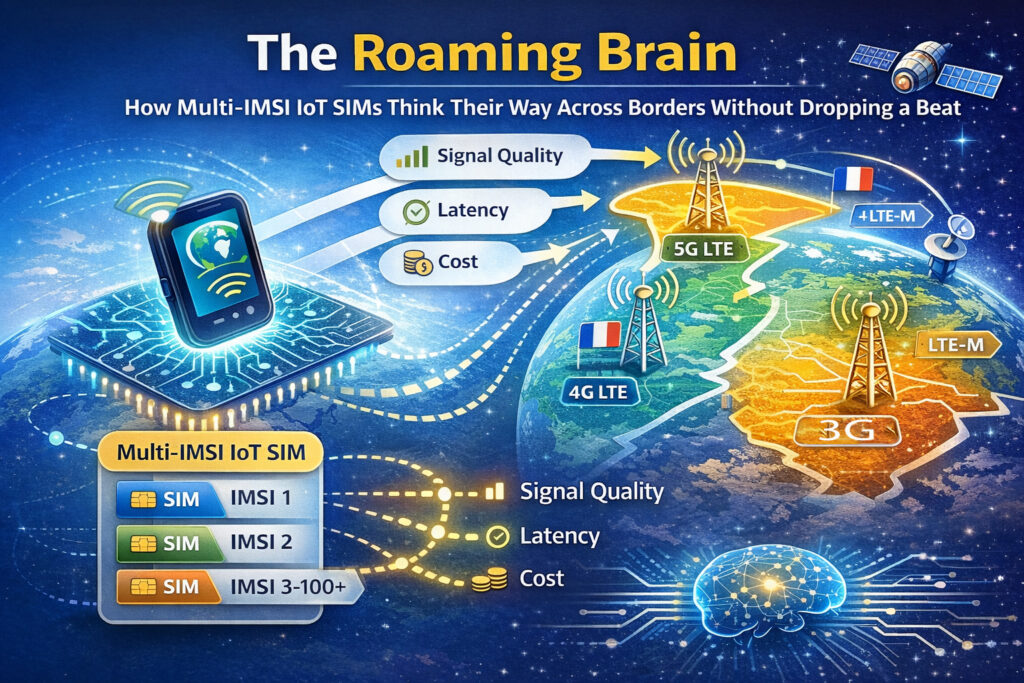
This is where the “brain” metaphor comes to life. The SIM, combined with the device firmware and the connectivity platform behind it, evaluates its environment and chooses which identity to use. The goal is simple in theory: connect to the best available network. In practice, that decision is shaped by a web of factors.
Signal strength, network availability, latency, cost rules, and policy controls all influence which profile becomes active. The result is a device that feels native wherever it lands, even if it crossed an ocean overnight.
How Devices See the World
When an IoT device powers on or loses its connection, it begins a scan. The radio module listens for nearby cell towers, measuring signal quality and identifying which networks are present. Each tower broadcasts a public identifier that tells the device which carrier it belongs to.
At this stage, the SIM steps in. It compares the detected networks against the list of profiles it can use. If the SIM has an IMSI that matches a local carrier, it can authenticate as a domestic subscriber rather than a roaming one.
This moment is a quiet negotiation. The device says, “Here is who I am.” The network replies, “Here is what I can offer.” If the handshake succeeds, data begins to flow.
To the application in the cloud, this entire exchange is invisible. The device simply appears online, as if it never left home.
Profile Switching in Motion
The real magic happens when conditions change.
Imagine a fleet vehicle crossing a border. On one side, it connects as a local subscriber using IMSI A. As it moves into the next country, that network fades and a new set of towers rises into view. The SIM recognizes that its current profile no longer provides the best option.
Depending on how the system is configured, the SIM can trigger a profile switch. This may happen through logic stored on the SIM itself or through instructions from a remote connectivity management platform.
The device briefly disconnects, rotates to a new IMSI, and re-authenticates on a different network. To the end user watching a dashboard, this may look like a momentary blip or nothing at all.
That seamlessness is the hallmark of a well-designed roaming brain.
Steering, No-Steering, and Trust
Not all roaming brains are built the same way.
Some multi-IMSI systems use what is called steering. In this model, the SIM or the backend platform directs the device toward preferred networks based on business rules. These rules might prioritize lower-cost carriers, stronger security postures, or contractual obligations.
Other systems follow a no-steering approach. Here, the device is free to attach to the strongest available network without being nudged toward a specific partner. This often results in better performance in remote or complex radio environments, where the “best” network can change minute by minute.
Trust becomes the central theme. Do you trust your business logic more, or the radio environment itself? The answer often depends on the use case.
For critical infrastructure or real-time applications, performance and reliability may outweigh cost optimization. For massive sensor deployments, predictability and budget control may take the lead.
The Role of the Connectivity Platform
The SIM’s brain does not work alone. Behind every intelligent IoT SIM strategy is a connectivity management platform that acts like a higher-level nervous system.
This platform collects data from millions of devices. It knows where they are, which networks they are using, how much data they consume, and how often they switch profiles. Over time, this information becomes a map of your global connectivity landscape.
With this map, operators can define policies. For example, devices in Region A should always prefer Network X unless signal strength falls below a certain threshold. Devices in Region B should avoid Network Y due to regulatory restrictions.
These policies can be pushed to devices remotely, shaping how their roaming brains behave without ever touching the hardware in the field.
Latency, Cost, and the Hidden Geography of Data
Choosing a tower is only part of the story. Where the data goes next matters just as much.
Some networks route roaming traffic back to a home country before sending it to the cloud. This can add latency and create unexpected data paths that complicate compliance with data residency laws.
Multi-IMSI strategies can reduce this detour. By connecting as a local subscriber, devices often gain access to local breakout points, sending data to nearby cloud regions instead of across continents.
The roaming brain is not just choosing a signal. It is choosing a route through the digital geography of the world.
When Things Go Wrong
Even the smartest brain needs a backup plan.
Networks fail. Towers go dark. Carriers experience outages. In these moments, the ability to fall back to another profile can be the difference between a minor inconvenience and a full-scale operational crisis.
A well-designed multi-IMSI SIM strategy includes rules for failure. If a connection drops repeatedly, the device can try a different network. If latency spikes beyond an acceptable range, it can switch profiles.
This kind of resilience is what allows global IoT systems to behave less like fragile chains and more like living organisms, adapting to their environment in real time.
Designing the Brain
Creating an effective roaming brain is as much about planning as it is about technology.
It starts with understanding where your devices will live, move, and operate. It continues with choosing connectivity partners that offer broad, reliable coverage and transparent management tools. It matures through testing in real-world conditions, not just lab environments.
The best strategies treat profile switching, network selection, and policy control as first-class design elements, not optional features.
The Future of Thinking SIMs
As eSIM and iSIM technologies become more widespread, the brain inside the device will grow even more flexible. Profiles will be downloaded and updated over the air. New networks will be added without physical intervention. Connectivity will become a living, evolving component of the device rather than a fixed part of its hardware.
In this future, the line between device and network will blur. Connectivity will feel less like a service and more like a sense.
The Final Connection
From the outside, a multi-IMSI IoT SIM looks like a small piece of plastic or a tiny chip soldered onto a board. Inside, it carries a remarkable responsibility.
It listens. It evaluates. It decides.
The roaming brain is what allows a device to cross borders, navigate networks, and keep data flowing as if the world were a single, seamless place. For organizations building global IoT systems, understanding how that brain works is not just a technical curiosity.
It is the key to designing connectivity that can think, adapt, and grow along with your ambitions.