
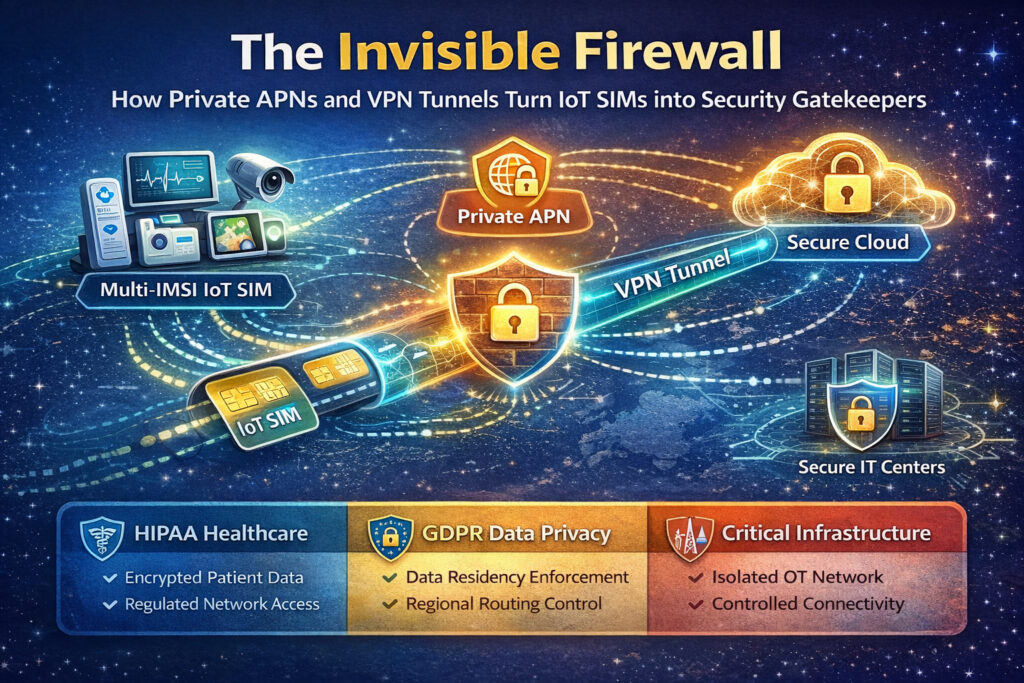
In the modern world of connected machines, data is constantly on the move. It flows from sensors in hospital wards, meters in power substations, trackers in shipping containers, and controllers on factory floors. Most of this movement happens silently, far from human eyes, yet the stakes could not be higher. A single exposed connection can become a doorway into critical systems, sensitive records, or physical infrastructure.
This is where the idea of the “invisible firewall” comes to life. Instead of relying solely on software running inside each device, many of today’s most secure IoT deployments build protection directly into the network itself. By using private APNs and VPN tunnels, IoT SIMs become more than connectivity tools. They become gatekeepers, deciding what can enter, what can leave, and where data is allowed to travel.
Let’s step behind the scenes of this hidden layer and explore how network-level security works in compliance-heavy industries.
Why the Public Internet Is a Risky Highway
Most consumer devices connect to the internet the same way your phone or laptop does. They attach to a carrier network, receive a public IP address, and send data out onto the open web. For everyday browsing, this is fine. For industrial systems, healthcare platforms, or national infrastructure, it can be a serious liability.
When IoT devices sit on the public internet, they become discoverable. Automated scanners can find exposed endpoints. Attackers can probe for weak credentials, outdated firmware, or misconfigured services. Even if the device itself is well protected, the network path it travels can pass through multiple uncontrolled environments.
Compliance-heavy industries often cannot afford this level of exposure. Regulations demand not just encryption, but controlled access, clear audit trails, and strict separation between operational networks and the public internet.
The Private APN: Your Own Digital Neighborhood
An APN, or Access Point Name, defines how a device connects to a mobile data network. In most consumer scenarios, the APN points to the carrier’s general internet gateway. A private APN changes that destination.
Instead of sending traffic out to the public web, a private APN routes all device data into a closed, private network environment. From there, it can be delivered directly to a company’s data center, cloud environment, or secure enterprise network.
Think of it as building a private road system that never merges with the main highway. Only authorized vehicles can enter, and every route is known and controlled.
This approach brings several powerful advantages. Devices are no longer reachable from the outside world. IP addresses can be fixed and predictable. Network policies can be enforced centrally, rather than individually on each device.
VPN Tunnels: Encrypting the Journey
While a private APN controls where data goes, a VPN tunnel controls how it gets there.
A VPN, or Virtual Private Network, creates an encrypted tunnel between two points on a network. In an IoT context, this often means a secure link between the mobile carrier’s private APN gateway and a company’s cloud or on-premise environment.
Inside this tunnel, data is wrapped in encryption, shielding it from interception or tampering as it crosses intermediate networks. Even if someone were able to see the traffic, it would appear as unreadable noise.
For compliance frameworks that require strong data protection in transit, this combination of private routing and encryption forms a robust foundation.
Turning IoT SIM cards into Gatekeepers
When private APNs and VPNs are integrated into an IoT SIM strategy, the IoT SIM itself becomes part of the security architecture.
The moment a device powers on, the SIM determines which APN it uses. If that APN points only to a private network, the device cannot reach the public internet at all. It can only communicate with approved endpoints inside the secure environment.
This shifts security from a reactive model to a preventive one. Instead of trying to detect and block threats after they reach the device, you prevent them from ever having a network path in the first place.
In effect, the SIM becomes a bouncer at the door of your digital infrastructure, checking every connection before it is allowed inside.
Compliance in the Real World
Industries like healthcare, energy, finance, and transportation operate under strict regulatory frameworks. These rules often specify how data must be protected, where it can be stored, and who can access it.
Healthcare IoT devices transmit highly sensitive patient information that must remain private, encrypted, and access-controlled at all times. By using a Private APN combined with encrypted VPN tunnels, device traffic is isolated from the public internet and routed only through approved healthcare networks and cloud environments.
In healthcare, patient information must be shielded from unauthorized access. In energy and utilities, control systems must be isolated from external networks to prevent sabotage. In finance, transaction data must travel through audited and controlled pathways.
Private APNs and VPN tunnels help meet these requirements by creating a clearly defined network boundary. Auditors can see exactly where data flows, which systems it touches, and how it is protected along the way.
This clarity simplifies compliance reporting and reduces the risk of unexpected findings during audits.
Scaling Security Without Scaling Complexity
One of the hidden challenges of IoT security is growth. A pilot deployment might involve a few dozen devices, each carefully configured by hand. A global rollout can involve thousands or millions.
Configuring firewalls, certificates, and network rules on each device quickly becomes unmanageable. Network-level security flips this model.
With a private APN, policies live in the network, not on the device. Adding a new device becomes a matter of activating a SIM and placing it into the correct security group. The same rules apply automatically, without manual intervention.
This approach keeps security consistent, even as deployments expand across regions and business units.
Data Residency and Digital Geography
Many regulations care not just about who can access data, but where that data physically travels. Some countries require that certain types of information remain within national or regional boundaries.
By using local breakout points combined with private APNs, organizations can control which cloud regions or data centers receive traffic from devices in specific locations. VPN tunnels can then connect those regional environments back to a central management platform in a controlled and compliant way.
The invisible firewall becomes a map as much as a barrier, guiding data through approved digital geography.
When the Network Becomes the Shield
There is a philosophical shift in this approach to security.
Instead of viewing the device as the primary line of defense, the network itself becomes the shield. Devices can be simpler, lighter, and more focused on their core function, while the heavy lifting of security happens in the connectivity layer.
This does not eliminate the need for device-level protections. It complements them, creating a layered model where multiple safeguards work together.
Designing for Trust and Transparency
A strong invisible firewall is not just about blocking threats. It is also about building trust with customers, partners, and regulators.
When organizations can clearly explain how data flows, how it is protected, and how access is controlled, they demonstrate maturity and responsibility. This transparency can become a competitive advantage in markets where security and compliance are key decision factors.
The Cost of Getting It Wrong
The alternative is often discovered in headlines.
Breaches, outages, and regulatory fines rarely stem from a single technical failure. They emerge from systems that were designed for convenience rather than resilience. Public exposure, unclear network paths, and inconsistent security controls create gaps that eventually get exploited.
Private APNs and VPN tunnels are not silver bullets, but they close some of the largest and most dangerous openings in global IoT architectures.
The Final Barrier
To the outside world, an IoT SIM card is a small piece of plastic or a tiny chip soldered onto a circuit board. Inside a secure deployment, it carries a much larger role.
It decides which network a device can see. It defines where data is allowed to go. It enforces boundaries that software alone cannot guarantee.
The invisible firewall lives in this quiet layer of connectivity, shaping every packet of data before it ever reaches the cloud.
For compliance-heavy industries, this is not just a technical feature. It is a foundation for trust, resilience, and long-term growth in a world where everything, and everyone, is connected.