
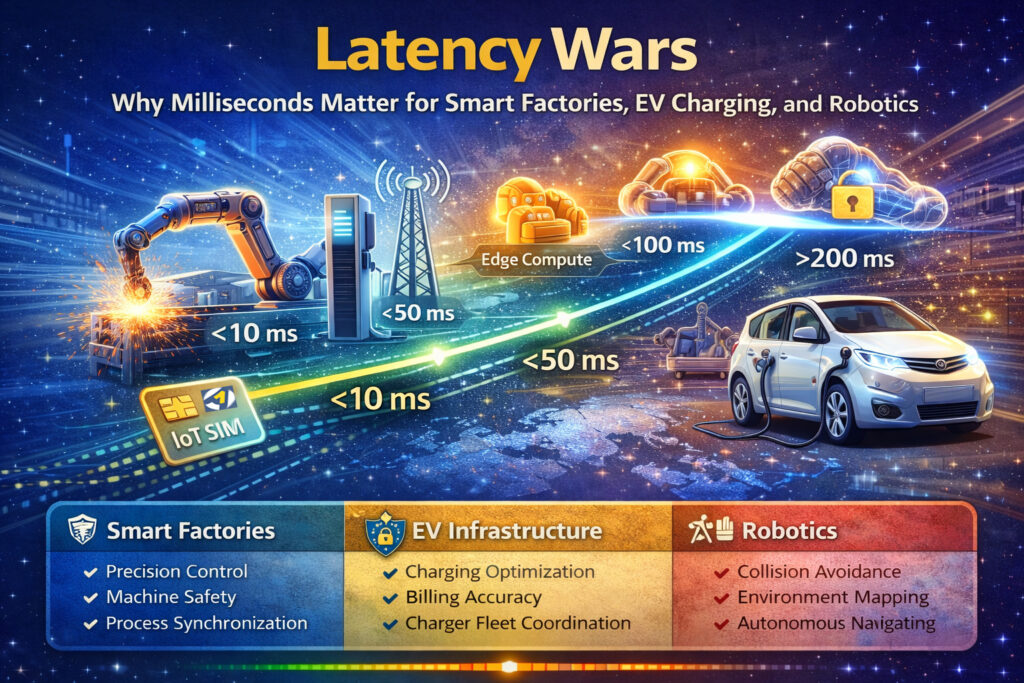
In the world of connected technology, speed is often measured in megabytes, gigabits, and processing power. Yet for industrial IoT, the most critical measurement is often much smaller and far more unforgiving: milliseconds.
A delay that humans would never notice can cause a robotic arm to misalign, a manufacturing line to slow, or an EV charging session to fail authentication. In environments where machines communicate constantly and decisions must happen in real time, latency becomes more than a technical metric. It becomes a competitive advantage, a safety requirement, and in some cases, the difference between success and shutdown.
Welcome to the latency wars, where every millisecond matters.
What Latency Really Means in IoT
Latency is the time it takes for data to travel from one point to another and back again. In consumer technology, high latency might mean a video buffering for a moment or a web page loading slowly. In industrial environments, it can mean something much more serious.
When a sensor detects a pressure change on a production line, that signal must be transmitted, processed, and responded to almost instantly. If the response is delayed, even by a fraction of a second, the result can be defective products, equipment damage, or safety risks for workers.
IoT SIM connectivity plays a key role in this chain. Every time a device sends data over a cellular network, it depends on signal quality, network routing, and infrastructure performance to keep latency low.
Smart Factories: Precision at Machine Speed
Smart factories are built on the idea that machines can communicate with each other in real time. Sensors monitor vibration, temperature, and performance. Automated systems adjust production levels, reorder materials, and optimize workflows.
In this environment, latency is not just a performance metric. It directly affects productivity.
Imagine a robotic assembly line where parts must be positioned within tight tolerances. If commands arrive late, even by milliseconds, machines may need to pause and recalibrate. Multiply that across thousands of operations per hour, and delays quickly add up.
Low-latency connectivity allows factory systems to respond instantly. Predictive maintenance systems can detect anomalies before breakdowns occur. Quality control systems can reject faulty components in real time. Production stays smooth, efficient, and safe.
Robotics: Timing Is Everything
Robots rely on constant communication with control systems, cloud platforms, and sometimes with each other. Whether it is a warehouse robot navigating aisles or an industrial arm welding components, timing is critical.
A delay in receiving instructions can result in missed movements, inefficient routing, or halted operations. In collaborative robotics, where machines work alongside humans, consistent low latency is also essential for safety.
Cellular IoT SIM connectivity enables mobile robots to stay connected across large facilities and even between locations. But not all networks perform the same. Network congestion, routing paths, and signal interference can introduce delays that disrupt precision tasks.
This is why many industrial deployments prioritize network reliability and low-latency performance over pure data speed.
EV Charging Networks: The Hidden Need for Speed
Electric vehicle charging infrastructure might not seem as time-sensitive as robotics or manufacturing, but latency plays a critical role behind the scenes.
Every time a driver plugs in, the charger communicates with backend systems to authenticate the session, confirm payment, and manage power distribution. These interactions must happen quickly to provide a smooth user experience.
High latency can cause slow authentication, failed session starts, or delays in billing data transmission. For operators managing thousands of charging stations, these small delays can translate into customer frustration and operational inefficiencies.
Reliable, low-latency cellular connectivity helps ensure chargers remain responsive and connected, even in remote or high-traffic locations.
The Role of Network Architecture
Latency is not determined by one factor alone. It is shaped by the entire path data takes from device to destination.
When an IoT device sends data, it travels through the local cellular tower, across carrier infrastructure, and often into cloud platforms for processing. The longer and more complex this path, the higher the latency.
Some roaming connections route data through distant home networks before reaching the cloud. This detour can add precious milliseconds. Multi-network IoT SIM strategies can reduce these delays by connecting devices to local networks and using regional breakout points.
The result is a shorter, faster path for data to travel.
4G, LTE-M, NB-IoT, and 5G: Choosing the Right Tool
Different cellular technologies offer different latency profiles.
4G LTE provides a strong balance between coverage, speed, and responsiveness, making it a reliable choice for many industrial applications.
LTE-M and NB-IoT are designed for low-power devices that send small amounts of data. While they are excellent for battery life and coverage, they may not always offer the ultra-low latency required for time-sensitive control systems.
5G brings the promise of extremely low latency, especially in private or dedicated network environments. For applications like autonomous robotics and real-time industrial control, 5G can open new possibilities.
The key is matching the technology to the use case. Not every deployment needs the lowest possible latency, but for mission-critical systems, the right connectivity choice can be transformative.
Edge Computing and the Race Against Time
One way organizations are reducing latency is by moving intelligence closer to the device. Edge computing allows data to be processed locally, rather than sending everything to a distant cloud server.
In a factory, this might mean analyzing sensor data on-site and sending only key insights to the cloud. In an EV charging network, local systems can handle authentication while syncing records centrally.
IoT SIM connectivity still plays an essential role, ensuring that edge systems remain connected, synchronized, and manageable across locations.
Latency as a Competitive Advantage
In industries where timing drives performance, low latency can set leaders apart.
Manufacturers can produce more with fewer errors. Logistics providers can coordinate fleets more efficiently. Energy companies can balance power loads more precisely. EV charging operators can deliver smoother experiences to drivers.
All of these gains come from shaving off milliseconds in communication time.
Planning for Performance
Designing a low-latency IoT deployment starts with understanding how quickly systems need to respond. It requires evaluating coverage, network quality, routing paths, and device placement.
Testing in real-world conditions is essential. A network that performs well in one location may behave differently in another. Monitoring tools can help identify latency patterns and reveal opportunities for optimization.
Choosing a connectivity partner with strong global coverage, intelligent routing, and transparent performance insights can make a significant difference.
The Future of Real-Time Connectivity
As automation expands, the demand for real-time communication will only grow. Factories will become more autonomous. Robotics will become more collaborative. EV infrastructure will become more dynamic and responsive.
In this future, latency will remain one of the defining factors of performance.
Milliseconds may be small, but their impact is enormous. They shape how machines respond, how systems coordinate, and how industries evolve.
The latency wars are not fought with headlines or announcements. They are fought quietly, inside networks and infrastructure, where every fraction of a second counts. For organizations building the next generation of connected systems, winning that battle starts with choosing the right connectivity foundation.