
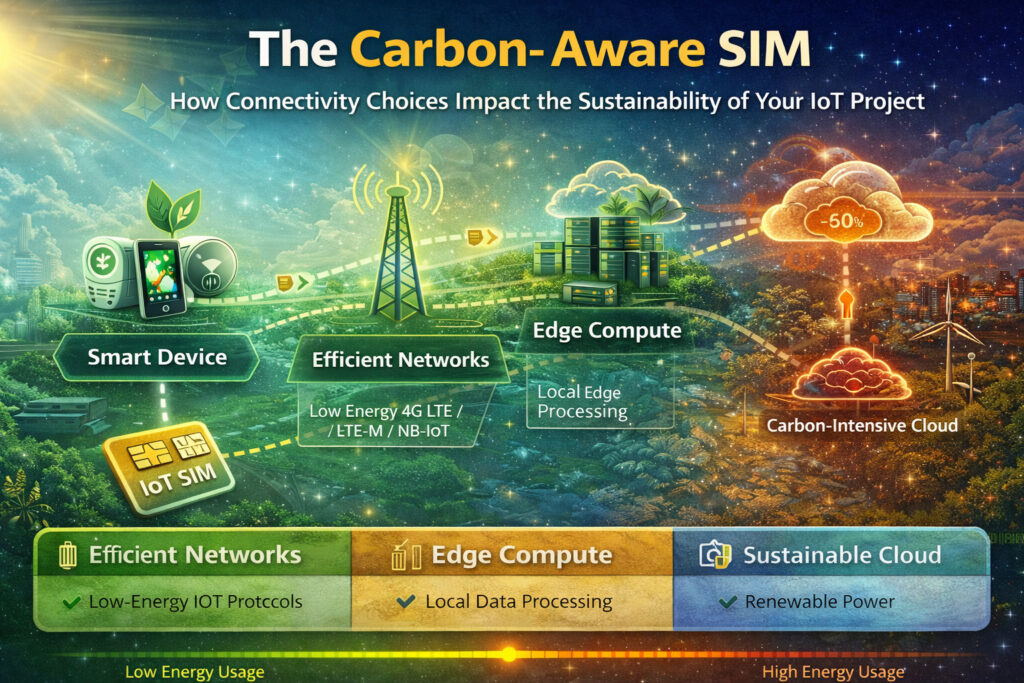
Sustainability is no longer a side conversation in technology. It sits at the center of strategy, investment, and innovation. Organizations deploying IoT solutions are not just measuring performance and uptime anymore. They are also asking deeper questions. How much energy does this deployment consume? How efficient is the network carrying our data? What is the long-term environmental impact of keeping millions of devices connected?
In this new landscape, connectivity is not just a technical decision. It is an environmental one. The idea of the “carbon-aware SIM” reflects a growing recognition that network choices, data routing, and device behavior all contribute to the overall sustainability footprint of an IoT project.
From smart agriculture to global logistics, the path your data takes can influence how much energy your deployment consumes and how efficiently your infrastructure operates. Understanding this hidden layer of impact is the first step toward building greener IoT systems.
The Hidden Energy Cost of Connectivity
Every connected device consumes power. Sensors wake up, transmit data, and return to sleep. Gateways collect information and forward it to cloud platforms. Networks carry those packets across towers, switching centers, and data centers.
Individually, each transmission uses only a small amount of energy. At scale, the numbers tell a different story. A deployment with hundreds of thousands or millions of devices sending data regularly creates a constant flow of energy demand across the network.
The choice of connectivity technology plays a major role in how much energy is used. Different cellular standards have different power profiles. Some are optimized for long battery life and minimal data transfer. Others prioritize speed and capacity. The key is matching the connectivity strategy to the use case in a way that avoids unnecessary energy consumption.
A carbon-aware SIM strategy begins by asking a simple question: are we using the right network for the job?
Low-Power Networks and Smarter Devices
Technologies like LTE-M and NB-IoT were designed with efficiency in mind. They allow devices to transmit small amounts of data using significantly less power than traditional cellular connections. For battery-powered sensors in remote environments, this can extend device life from months to years.
Longer battery life means fewer site visits, fewer battery replacements, and less transportation. These small changes can add up to a meaningful reduction in emissions, especially in deployments spread across wide geographic areas.
By selecting SIM profiles that prioritize low-power network access when possible, organizations can reduce the energy footprint of their devices without sacrificing connectivity.
LTE-M / NB-IoT vs 4G / 5G: Power Consumption Profiles and Sustainability Impact
When designing a carbon-aware IoT deployment, the choice of cellular technology directly affects energy use, battery life, maintenance frequency, and overall environmental footprint. Not all networks are built for the same purpose. Some prioritize speed and capacity, while others are engineered for efficiency and endurance. Understanding how LTE-M and NB-IoT compare to traditional 4G and emerging 5G connectivity is key to building a more sustainable system.
Designed for Efficiency vs Designed for Performance
LTE-M and NB-IoT were created specifically for IoT devices that transmit small amounts of data at regular intervals. These technologies focus on minimizing power draw, maximizing battery life, and maintaining reliable connectivity in challenging environments.
4G LTE and 5G, on the other hand, were built to support high data throughput, video streaming, and real-time applications. They deliver speed and responsiveness, but that performance typically comes with higher energy consumption.
The result is a clear divide between “efficient” networks and “high-performance” networks.
Typical Power Profiles at a Glance
While exact consumption varies by device and environment, the general patterns are consistent:
NB-IoT (Lowest Power)
- Designed for ultra-low data usage and infrequent transmissions
- Devices can sleep for long periods between updates
- Battery life can extend 5–10+ years in many deployments
- Ideal for sensors, meters, and environmental monitoring
LTE-M (Low Power, Balanced)
- Slightly higher power use than NB-IoT, but more flexible
- Supports mobility, firmware updates, and moderate data rates
- Often achieves multi-year battery life
- Well suited for trackers, wearables, and smart infrastructure
4G LTE (Moderate to High Power)
- Higher transmission speeds require more energy per session
- Frequent connections and stronger radios increase consumption
- Best for devices needing consistent, real-time data exchange
5G (Highest Performance, Variable Power)
- Extremely low latency and high throughput capabilities
- Can consume significantly more power depending on usage
- Private or optimized 5G networks can improve efficiency in controlled environments
In short, the more data you push and the faster you push it, the more energy you use.
Battery Life and the Sustainability Ripple Effect
Power consumption does not only affect the device itself. It sets off a chain reaction that influences sustainability across the entire deployment.
Lower-power networks like NB-IoT and LTE-M enable:
- Longer battery life
- Fewer maintenance visits
- Reduced shipping and replacement cycles
- Lower transportation emissions
In contrast, higher-power connectivity may require:
- More frequent charging or battery replacement
- Increased service visits
- Greater operational overhead
For large deployments, these differences compound quickly. A smart metering project with hundreds of thousands of devices running on NB-IoT could operate for years without intervention. The same deployment on a higher-power network might require significantly more maintenance activity over time.
Transmission Behavior Matters More Than Peak Speed
One of the biggest misconceptions is that faster networks are always more efficient. In reality, efficiency depends on how often a device connects and how much data it sends.
Low-power IoT technologies use features such as:
- Power Saving Mode (PSM)
- Extended Discontinuous Reception (eDRX)
- Scheduled transmission windows
These allow devices to remain in deep sleep for long periods, waking only when necessary. This drastically reduces energy consumption.
By contrast, devices using 4G or 5G often maintain more active connections, especially if they are sending frequent updates, streaming data, or supporting real-time interactions.
Choosing the Right Network for the Right Job
The most sustainable connectivity strategy is not about choosing the lowest-power option in every case. It is about choosing the most appropriate technology for the workload.
NB-IoT is ideal for:
- Smart meters
- Environmental sensors
- Agricultural monitoring
- Static infrastructure
LTE-M works well for:
- Asset tracking
- Mobile sensors
- Wearables and health devices
- Smart city infrastructure
4G LTE is often necessary for:
- Video-enabled devices
- Industrial equipment needing regular updates
- High-frequency telemetry
5G shines in:
- Robotics and automation
- Smart factories
- Autonomous systems
- Ultra-low latency applications
Each technology plays a role. The key is avoiding the use of high-power connectivity when low-power alternatives can achieve the same result.
The Role of Smart Connectivity Management
Multi-network IoT SIM strategies can help balance performance and efficiency. Devices can be configured to use lower-power networks for routine communication and shift to higher-performance networks only when necessary.
For example:
- A device may use NB-IoT for regular status updates
- Switch to LTE-M for firmware downloads
- Use 4G only when large data transfers are required
This layered approach helps minimize energy usage while preserving flexibility.
Power Efficiency at Scale
At small scale, power consumption differences may seem minor. At scale, they define the long-term sustainability profile of an IoT project.
A single device saving a small amount of energy each day may not seem significant. Multiply that by hundreds of thousands or millions of devices over years of operation, and the impact becomes substantial.
Choosing LTE-M or NB-IoT over higher-power alternatives, where appropriate, can mean:
- Lower total energy consumption
- Longer hardware lifecycles
- Reduced operational emissions
Sustainability Is a Network Decision
Connectivity is often treated as a technical afterthought. In reality, it plays a central role in shaping the environmental footprint of a deployment.
LTE-M and NB-IoT provide a foundation for energy-efficient, long-life IoT systems. 4G and 5G deliver performance where speed and responsiveness matter most. A carbon-aware strategy uses each where it makes sense, rather than defaulting to the fastest option available.
In the broader sustainability conversation, the network is not just a pipeline for data. It is a lever that can quietly influence energy use across the entire lifecycle of an IoT deployment.
Data Efficiency Is Energy Efficiency
Not all data is equally valuable. Some IoT deployments collect more information than they truly need. Every extra transmission consumes power on the device and adds load to the network infrastructure.
Carbon-aware deployments focus on sending the right data at the right time. Edge computing plays an important role here. Instead of transmitting every data point to the cloud, devices or local gateways can filter, process, and summarize information before sending only the most relevant insights.
This approach reduces network traffic and lowers energy consumption across the entire system. Less data moving through the network means fewer resources required to carry, store, and process it.
The Role of Network Selection
Multi-network IoT SIMs bring another sustainability advantage. By allowing devices to connect to the strongest and most efficient local network, they can reduce transmission retries and improve signal quality.
When a device struggles to maintain a weak connection, it uses more power trying to send the same data over and over again. Stronger connections mean faster transmissions, fewer retries, and lower overall energy use.
In this way, network selection becomes an environmental factor. A well-designed connectivity strategy helps devices operate more efficiently simply by ensuring they are always connected to the best available signal.
Routing and the Geography of Data
Where data travels matters too. Some connectivity setups route data through distant regions before it reaches its destination. These longer paths require more infrastructure and more energy.
Local breakout and regional routing strategies can help shorten the distance data travels. By sending information to nearby data centers instead of routing everything through a single central hub, organizations can reduce latency and energy consumption at the same time.
A carbon-aware SIM does not just connect devices. It supports smarter routing decisions that keep data paths as short and efficient as possible.
Infrastructure Efficiency at Scale
At large scale, small efficiencies multiply. If each device saves just a tiny amount of energy, the cumulative impact across millions of devices can be significant.
This is especially true in industries like smart metering, environmental monitoring, and asset tracking. These deployments often operate continuously for years. Improving connectivity efficiency can reduce operational costs while also supporting sustainability goals.
Network providers are also investing in greener infrastructure. Modern cellular networks are becoming more energy-efficient, and many operators are shifting toward renewable energy sources for their towers and data centers. Choosing connectivity partners with strong sustainability commitments can amplify the environmental benefits of an IoT deployment.
Reducing Field Visits and Truck Rolls
One of the most overlooked environmental impacts of IoT comes from maintenance. When devices fail or batteries die, technicians must travel to repair or replace them. Each trip consumes fuel and creates emissions.
Reliable connectivity plays a key role in reducing these visits. Strong network coverage and stable connections help devices operate longer without interruption. Remote management capabilities allow teams to troubleshoot, update, and optimize devices without leaving the office.
Fewer truck rolls mean lower emissions, reduced operational costs, and a smaller overall carbon footprint.
Sustainable Deployment Strategies
Building a greener IoT system is not just about choosing efficient hardware. It requires a holistic approach to deployment.
Organizations can start by carefully planning where devices will be placed and how often they need to transmit data. They can use connectivity platforms to monitor usage patterns and identify opportunities to reduce unnecessary transmissions. They can also adopt flexible SIM strategies that allow profiles and settings to be adjusted over time as technology evolves.
This adaptability is key. As networks become more efficient and new standards emerge, a flexible connectivity approach allows organizations to take advantage of improvements without replacing hardware.
Measuring What Matters
To truly understand the environmental impact of connectivity, organizations need visibility. Data on device behavior, network usage, and transmission patterns can reveal how energy is being consumed.
With the right insights, teams can optimize transmission intervals, adjust device settings, and select more efficient network profiles. Over time, these changes can lead to measurable reductions in energy use.
Sustainability becomes not just a goal, but a managed performance metric.
The Future of Green Connectivity
As sustainability becomes a priority across industries, the role of connectivity will continue to evolve. Future networks will be designed with efficiency in mind from the ground up. Devices will become smarter about when and how they communicate. Connectivity platforms will provide deeper insights into energy usage and environmental impact.
The concept of the carbon-aware SIM will grow along with these advances. Connectivity will not just support operations. It will support environmental responsibility.
The Final Connection
In many IoT discussions, connectivity is treated as a utility. Something that simply needs to work. But the choices made at this layer can shape the efficiency, cost, and sustainability of an entire deployment.
A carbon-aware SIM strategy is about more than keeping devices online. It is about connecting them in a way that minimizes waste, reduces energy use, and supports long-term environmental goals.
For organizations building the next generation of connected systems, sustainability is becoming part of the design process. And in that process, connectivity is no longer invisible. It is a key part of building a smarter, greener future.