
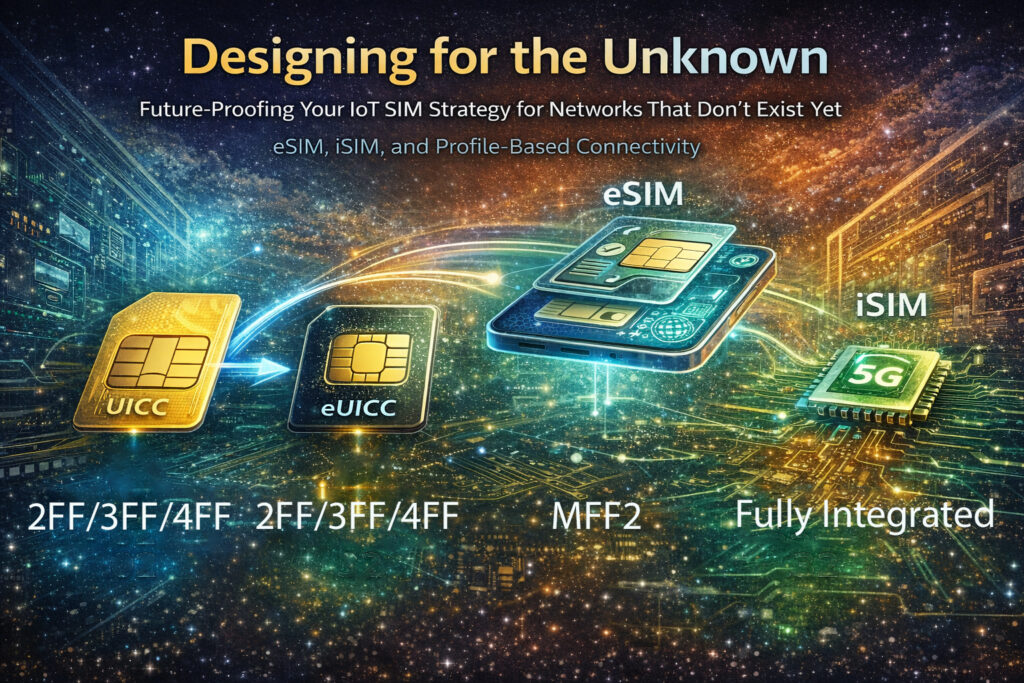
Future-Proofing Your IoT SIM Strategy for Networks That Don’t Exist Yet
IoT deployments are built for longevity. Devices placed in the field today are often expected to operate for five, ten, or even fifteen years. But the networks they rely on are anything but static. Cellular standards evolve, carriers merge, spectrum shifts, and entire generations of connectivity rise and fall.
Designing an IoT solution without accounting for this change is like building a bridge that assumes the river will never move.
Future-proofing your IoT SIM strategy means preparing for networks that do not yet exist, technologies that are still emerging, and requirements that will evolve over time. At the center of this strategy are eSIM, iSIM, and profile-based connectivity, along with the foundational shift from traditional UICC SIMs to eUICC architectures.
Let’s unpack what this means in the real world.
The Problem with Static Connectivity
Traditional IoT deployments often rely on a fixed SIM profile tied to a single carrier or roaming agreement. This works well at the start, but over time, limitations emerge:
- Networks sunset older technologies (like 2G and 3G)
- Coverage gaps appear as deployments expand
- Pricing structures change
- Regulatory requirements evolve
Replacing SIM cards in the field is expensive, slow, and sometimes impossible. Devices embedded in industrial equipment, underground infrastructure, or remote environments cannot easily be accessed.
Future-proofing begins by eliminating the need for physical replacement.
UICC vs eUICC: The Foundation of Flexibility
At the heart of SIM evolution is the shift from UICC to eUICC.
UICC (Universal Integrated Circuit Card)
- Traditional SIM architecture
- Stores a single operator profile
- Changing carriers requires physical SIM replacement
- Limited flexibility once deployed
UICC SIMs are reliable and widely used, but they are static by design.
eUICC (Embedded Universal Integrated Circuit Card)
- Supports multiple operator profiles
- Profiles can be downloaded, updated, or switched remotely (OTA)
- Enables remote provisioning and lifecycle management
- Foundation for eSIM and iSIM technologies
An eUICC SIM transforms connectivity from a fixed configuration into a dynamic system.
Instead of asking “Which network should this device use?” once, you can ask it continuously over the device’s lifetime.
eSIM: Remote Control for Connectivity
An eSIM is essentially an eUICC-capable SIM that allows remote profile management.
Key capabilities include:
- Over-the-air (OTA) profile downloads
- Remote carrier switching
- Multi-network provisioning
- Lifecycle updates without physical access
For global IoT deployments, this is a game changer.
A device deployed in Europe today can be reconfigured for Asia tomorrow without ever being touched. As networks evolve, profiles can be updated to maintain compatibility and performance.
iSIM: Connectivity Moves Inside the Chip
The next evolution is iSIM (Integrated SIM).
Instead of being a separate hardware component, iSIM functionality is embedded directly into the device’s main chipset.
Benefits of iSIM:
- Reduced hardware footprint
- Lower power consumption
- Improved security (fewer physical attack surfaces)
- Simplified device design
For ultra-compact or high-volume devices, iSIM represents the future of connectivity.
From a strategy perspective, iSIM continues the trend: connectivity becomes software-defined, not hardware-bound.
| Feature | SIM | eSIM | iSIM |
|---|---|---|---|
| Physical Card | ✅ | ❌ | ❌ |
| Separate Chip | ❌ | ✅ | ❌ |
| Built into SoC | ❌ | ❌ | ✅ |
| Remote Provisioning | ❌ | ✅ | ✅ |
| Space Efficiency | Low | Medium | Ultra High |
| Ideal For | Phones | Phones + IoT | Mass IoT |
eUICC Standards: .02 vs .32 Explained
Not all eUICC implementations are the same. The GSMA standards define how remote SIM provisioning works, and two key specifications matter in IoT:
eUICC M2M Standard (.02)
- Designed for machine-to-machine (M2M) deployments
- Uses a server-driven model
- Typically controlled by the operator
- Less flexible for end-user profile management
- Common in early IoT deployments
This model works well for fixed deployments but can limit flexibility when multiple operators or dynamic switching is required.
eUICC Consumer / IoT Standard (.32)
- More flexible and scalable architecture
- Supports remote profile management via standardized APIs
- Enables multi-operator ecosystems
- Better suited for modern IoT and global deployments
- Aligns with eSIM experiences on smartphones
The .32 standard shifts control closer to the enterprise or platform provider, enabling more dynamic connectivity strategies.
Profile-Based Connectivity: The Real Game Changer
Future-proofing is not just about hardware. It is about how connectivity is managed over time.
Profile-based connectivity allows devices to:
- Store multiple operator profiles
- Switch profiles based on location or performance
- Download new profiles as networks evolve
- Retire outdated profiles automatically
This creates a living connectivity layer that adapts alongside your deployment.
For example:
- A device may use Profile A in North America
- Switch to Profile B in Europe
- Download Profile C when a new 5G IoT network becomes available
All without physical intervention.
Designing for Network Evolution
To future-proof your IoT SIM strategy, you need to design with change in mind.
1. Plan for Network Sunset Events
2G and 3G shutdowns have already disrupted many deployments. Future networks will also evolve. Ensure your devices can adapt through profile updates.
2. Prioritize Multi-Network Access
Avoid single-operator lock-in. Multi-IMSI or profile-based strategies provide resilience as network conditions change.
3. Enable Remote Provisioning
Every device should be manageable without physical access. OTA updates are no longer optional.
4. Separate Hardware from Connectivity Logic
Use eUICC/eSIM/iSIM to decouple device hardware from network identity.
5. Choose Forward-Compatible Standards
Favor eUICC .32-based solutions where possible for long-term flexibility.
The Cost of Standing Still
The risk of not future-proofing is not immediate failure. It is gradual limitation.
Devices may:
- Lose connectivity as networks shut down
- Become stuck on suboptimal carriers
- Incur higher roaming costs
- Require expensive replacement programs
What begins as a technical decision becomes a business constraint.
The Shift to Software-Defined Connectivity
The broader trend is clear: connectivity is becoming software-defined.
Just as cloud computing abstracted hardware into scalable services, eSIM and iSIM are abstracting connectivity into dynamic, programmable layers.
This enables:
- Faster deployment into new markets
- Real-time optimization of network performance
- Continuous adaptation to regulatory changes
- Longer device lifecycles
Connectivity becomes something you manage, not something you install once and forget.
Designing for the Unknown
The phrase “future-proofing” can be misleading. You cannot predict every change that will happen over the next decade.
What you can do is design systems that adapt to change.
That means:
- Choosing flexible SIM architectures
- Embracing remote provisioning
- Leveraging profile-based connectivity
- Planning for continuous evolution
The goal is not to eliminate uncertainty. It is to build systems that thrive within it.
The Final Signal
IoT deployments are long-term investments operating in a rapidly changing connectivity landscape.
UICC SIMs represent a fixed past.
eUICC, eSIM, and iSIM represent a dynamic future.
By adopting flexible standards like eUICC .32 and embracing profile-based connectivity, organizations can ensure their devices remain connected, competitive, and operational no matter how networks evolve.
Because in IoT, the biggest risk is not what you don’t know.
It is what you assume will never change.