
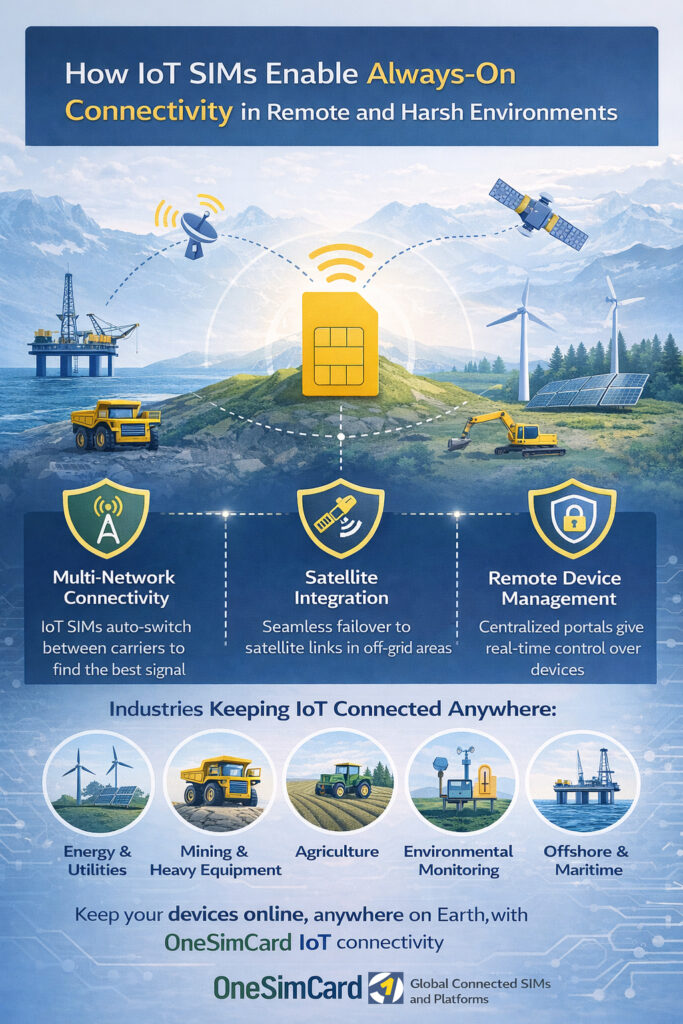
Keeping Critical Systems Connected Where Traditional Networks Fail
From offshore oil rigs and wind farms to deserts, mountains, and polar research stations, many of today’s most important operations take place far beyond the reach of traditional connectivity. In these remote and harsh environments, reliable communication isn’t a convenience—it’s a necessity. Equipment must remain online, data must flow continuously, and downtime can mean safety risks, regulatory violations, or millions of dollars in losses.
This is where IoT SIM cards play a crucial role. Purpose-built for machine connectivity, IoT SIMs provide the resilient, secure, and flexible communication layer required to keep devices connected—no matter how extreme the conditions.
🌍 The Connectivity Challenge in Remote Environments
Remote environments introduce unique challenges that standard consumer connectivity simply isn’t designed to handle:
- Sparse or inconsistent network coverage
- Extreme temperatures (heat, cold, humidity)
- Limited physical access for maintenance
- Unreliable power sources
- Moving assets (ships, vehicles, equipment)
- Harsh physical conditions (dust, vibration, corrosion)
In these scenarios, even brief connectivity gaps can disrupt operations. For industries such as energy, mining, agriculture, transportation, defense, and environmental monitoring, always-on communication is mission-critical.
📶 Why Consumer SIMs Fail in Harsh Conditions
Consumer SIM cards are built for people, not machines. They typically rely on:
- A single carrier
- Network steering, which may lock devices to suboptimal signals
- Dynamic IP addressing
- Short lifecycle expectations
- Minimal remote management capabilities
In remote areas, this leads to frequent dropouts, roaming restrictions, and a lack of control when things go wrong. Once deployed, consumer SIMs often require physical intervention—an unrealistic expectation for devices located hundreds of miles away.
🔑 What Makes IoT SIMs Different?
IoT SIM cards are engineered specifically for global, long-term, and unattended device connectivity. They are designed to withstand environmental extremes and network variability while providing constant communication.
Key capabilities include:
- Multi-network and multi-IMSI connectivity
- Non-steered network selection
- Global roaming without restrictions
- Extended temperature tolerance
- Long operational lifespan (10+ years)
- Remote provisioning and management
- Enterprise-grade security features
These features work together to ensure devices stay online—even when conditions are unpredictable.
🔄 Multi-Network Connectivity: The Foundation of Always-On IoT
One of the most important advantages of IoT SIMs is multi-network connectivity. Instead of relying on a single carrier, IoT SIMs can connect to multiple mobile networks within a region or country.
Why this matters in remote environments:
- If one network degrades or goes offline, the device automatically switches to another
- Coverage gaps are minimized
- Connectivity adapts dynamically as conditions change
With non-steered IoT SIMs, devices choose the strongest available signal rather than being forced onto a preferred carrier. This is especially critical in rural or rugged areas where network quality can fluctuate dramatically.
🛰️ Extending Reach with Hybrid Connectivity
In extremely remote locations—such as oceans, deserts, or mountainous regions—cellular coverage may be intermittent or nonexistent. Many IoT deployments combine cellular IoT SIMs with satellite connectivity to ensure uninterrupted communication.
In hybrid setups:
- Cellular networks are used whenever available
- Satellite connectivity provides fallback coverage
- Data transmission continues seamlessly, even outside terrestrial coverage zones
This approach is widely used in maritime shipping, oil and gas exploration, environmental research, and emergency response systems.
🔐 Secure Communication in Uncontrolled Environments
Remote deployments are often exposed to higher security risks due to limited physical oversight. IoT SIMs provide built-in security measures that protect devices and data even in uncontrolled environments.
These include:
- Private APNs that isolate traffic from the public internet
- Private static IPs for predictable, secure routing
- VPN and IPsec tunnels for encrypted communication
- SIM-to-device binding (IMEI locking) to prevent misuse
- Closed-loop network routing
This ensures sensitive data—such as operational metrics, sensor readings, or safety alerts—remains protected from interception or tampering.
🧭 Centralized Control from Anywhere
Managing remote devices is only possible if connectivity can be monitored and controlled remotely. IoT SIM management platforms provide centralized visibility into every deployed device, regardless of location.
With a single dashboard, organizations can:
- Monitor connectivity status in real time
- Track data usage and session history
- Receive alerts when devices go offline
- Suspend or reactivate SIMs instantly
- Apply configuration changes remotely
- Integrate with enterprise systems via APIs
This level of control dramatically reduces the need for costly site visits and enables proactive maintenance.
🏭 Real-World Use Cases in Harsh Environments
Energy and Utilities
Wind turbines, solar farms, pipelines, and substations are often located in remote areas. IoT SIMs enable continuous monitoring of performance, safety, and maintenance needs—preventing outages and improving efficiency.
Mining and Construction
Heavy machinery operates in dusty, high-vibration, and extreme-temperature environments. Connected sensors powered by IoT SIMs transmit health data and location information to prevent equipment failure and improve safety.
Agriculture
Smart irrigation systems, soil sensors, and livestock trackers rely on IoT SIMs to operate across vast rural areas with limited infrastructure—ensuring crops and animals are monitored around the clock.
Maritime and Offshore Operations
Ships, platforms, and containers remain connected at sea using IoT SIMs with satellite fallback, enabling asset tracking, environmental monitoring, and compliance reporting.
Environmental Monitoring
Weather stations, seismic sensors, and wildlife tracking devices are deployed in some of the harshest conditions on Earth. IoT SIMs allow scientists to collect real-time data without constant human presence.
🧠 Designed for Long Lifecycles
Remote devices are often installed with the expectation that they will operate for many years without physical intervention. IoT SIMs are built for this reality.
Features such as:
- Industrial-grade durability
- Extended temperature ranges
- Over-the-air profile updates
ensure that connectivity evolves without replacing hardware—even as networks change over time.
⚙️ The OneSimCard IoT Advantage
OneSimCard IoT delivers global connectivity solutions purpose-built for remote and harsh environments, including:
- Coverage in 200+ countries and territories
- Access to 300+ carrier networks
- Multi-IMSI, non-steered IoT SIMs
- Private APN, VPN, and static IP options
- Centralized SIM management portal
- Satellite integration support
- Long-lifecycle SIM solutions
Whether devices are deployed in deserts, oceans, mountains, or industrial zones, OneSimCard IoT ensures they remain securely connected—anywhere, anytime.
🚀 Conclusion: Connectivity Without Compromise
Remote and harsh environments no longer have to mean unreliable communication. With the right IoT SIM strategy, organizations can achieve always-on connectivity, real-time visibility, and enterprise-grade security—no matter where their devices operate.
IoT SIMs are more than just connectivity—they are the foundation that allows modern infrastructure, energy systems, logistics networks, and scientific research to function where traditional networks cannot.
In the most challenging environments on Earth, IoT SIMs keep your devices talking—when it matters most.