
Why Continuous Connectivity Is the Secret to Smarter, Safer, More Efficient Operations
Across manufacturing floors, energy grids, logistics networks, and industrial sites worldwide, machines work around the clock to keep businesses moving. When equipment fails unexpectedly, the consequences can be severe — production downtime, emergency repair costs, safety risks, damaged inventory, delayed shipments, and unhappy customers.
But what if machines could warn you before something breaks?
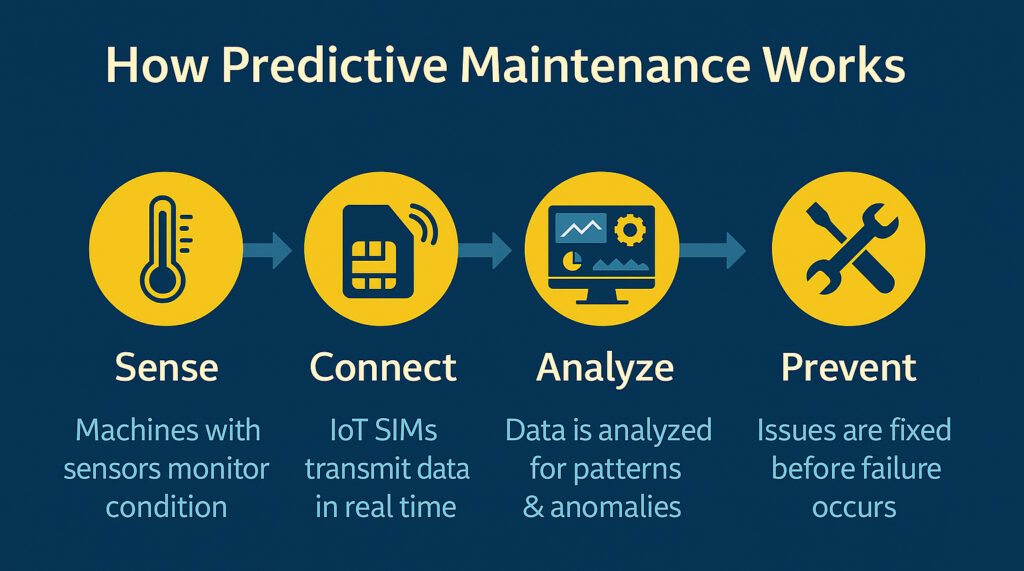
This is the power of predictive maintenance, where IoT-enabled sensors, analytics, and always-on connectivity allow companies to anticipate problems instead of reacting after the fact. And none of it works without one critical component: the IoT SIM card.
IoT SIMs give machines a continuous voice — communicating performance data, health metrics, and early warning signs in real time, no matter where they operate. From remote oil fields to urban data centers, IoT SIMs ensure your devices stay connected, monitored, and productive.
🔧 What Is Predictive Maintenance?
Predictive maintenance uses connected sensors and analytics to monitor the condition of equipment and predict when a part is likely to fail. Instead of performing scheduled maintenance at set intervals — or waiting for something to break — companies use real-time data to make smarter decisions.
Typical monitored parameters include:
- Temperature
- Vibration and rotational speed
- Pressure and fluid levels
- Electrical current and voltage
- Humidity
- Acoustic anomalies
- Component wear indicators
Using IoT sensors and a reliable data pipeline, organizations gain insights into machine behavior and detect anomalies early. The result is longer equipment life, fewer breakdowns, and significantly reduced operational costs.
📡 IoT SIM Cards: The Backbone of Predictive Maintenance
Predictive maintenance relies on real-time, uninterrupted communication between sensors, machines, and monitoring platforms. This is exactly why IoT SIM cards are essential.
Unlike consumer SIMs — which depend on a single carrier and are built for human behavior — IoT SIM cards are engineered for global machine communication. They provide industrial hardware with reliable, secure, and flexible connectivity at scale.
Here’s how IoT SIMs enable predictive maintenance to thrive.
🔍 1. Continuous, Real-Time Data Flow
Predictive maintenance only works when data is consistent, accurate, and always available.
IoT SIM cards ensure that machines remain connected by offering:
- Multi-network connectivity
- Automatic network switching
- Non-steered SIM profiles ensuring devices select the best available signal
- Coverage across 200+ countries (OneSimCard IoT, for example)
Whether a generator is running in a remote solar farm or a conveyor is operating inside a dense manufacturing facility, IoT SIMs ensure that performance data reaches the monitoring system without interruption.
🔐 2. Secure Transmission of Sensitive Operational Data
A predictive maintenance system is only as trustworthy as the integrity of its data.
IoT SIMs support robust cybersecurity features such as:
- Private static IPs
- Encrypted VPN tunnels
- Private APNs for isolating device traffic
- IMEI locking to prevent SIM misuse
- Data Limits to prevent a rogue device tearing through data
The result: data from machines flows through secure, controlled pathways, protecting operational intelligence, preventing unauthorized access, and cost control.
For industries handling proprietary processes — manufacturing, energy, logistics — this level of security is mission-critical.
🌍 3. Global Scalability Across Diverse Environments
Predictive maintenance is most powerful when applied across all assets — not just a handful.
IoT SIM cards enable large-scale deployments by working consistently across:
- Harsh outdoor environments
- Mobile or moving equipment
- Isolated industrial zones
- Multiple countries and networks
- Air, sea, and land transportation
From wind turbines in the North Sea to refrigerated trucks crossing borders, IoT SIMs provide a single unified connectivity solution for every machine in the network.
🧭 4. Centralized Management of Thousands of Devices
Managing IoT-enabled equipment across multiple locations can be overwhelming — unless you have a powerful SIM management system.
With an IoT SIM portal, organizations can:
- Activate or deactivate SIMs instantly
- View data usage per device in real time
- Track network connectivity and signal quality
- Detect offline or malfunctioning units
- Automate alerts and notifications
- Integrate with existing systems via APIs
This ensures that predictive maintenance doesn’t introduce complexity — instead, it centralizes oversight and simplifies operational workflows.
🤖 5. Enabling AI and Machine Learning Insights
Predictive maintenance systems often use AI-powered analytics to identify subtle patterns and predict failures with high accuracy.
This requires large volumes of high-quality, real-time data, such as:
- Microsecond-level vibration changes
- Heat signatures
- Irregular pressure fluctuations
- Lifetime wear metrics
IoT SIMs ensure that the machine learning engine behind predictive maintenance receives the data it needs. Without stable connectivity, AI models degrade — and predictive accuracy falls apart.
IoT SIMs keep the data flowing so AI can keep predicting.
🏭 Real-World Use Cases Across Industries
Manufacturing
Factory machines equipped with IoT sensors send early warnings about overheating motors, misaligned components, or lubrication issues. This prevents catastrophic downtime and keeps assembly lines running.
Transportation & Fleet Management
IoT SIMs connect sensors in vehicles to monitor engine performance, brake wear, tire pressure, and battery health — reducing roadside breakdowns and improving fleet safety.
Energy & Utilities
Wind turbines, transformers, pipelines, and generators transmit performance data continuously. Predictive alerts help prevent outages and optimize maintenance schedules.
Cold Chain & Refrigeration
Connected sensors monitor compressor cycles, coolant pressure, and temperature anomalies — preventing spoilage and ensuring regulatory compliance.
Construction & Heavy Equipment
IoT connectivity helps track equipment usage, detect wear, and anticipate mechanical failures in machinery like cranes, excavators, and loaders.
💰 The Financial Impact: Predictive Maintenance Pays for Itself
Studies show that predictive maintenance can:
- Reduce breakdowns by up to 70%
- Lower maintenance costs by 25–40%
- Extend machine lifespan by years
- Increase operational uptime significantly
Compared to preventive maintenance (fixed schedule) or reactive maintenance (fix when broken), predictive maintenance provides the highest ROI.
IoT SIMs make this possible by ensuring continuous operational intelligence.
⚙️ The OneSimCard IoT Advantage
OneSimCard IoT provides a global, enterprise-grade connectivity platform built for predictive maintenance:
- 400+ networks in 200+ countries
- Multi-IMSI SIMs for maximum uptime
- Non-steered connectivity for best-signal selection
- Private APNs, VPNs, and static IP options
- Centralized IoT SIM Management Portal
Whether you’re monitoring factory robots, energy systems, or remote industrial machinery, OneSimCard IoT keeps your devices connected, secure, and communicating nonstop.
🚀 Final Thoughts: The Future of Maintenance Is Predictive — and Connected
Machines don’t fail without warning — they send signals. With IoT SIM cards powering predictive maintenance, organizations can listen to their equipment in real time and take action long before a failure occurs.
The result is a safer, more efficient, and more profitable operation.
With the right IoT connectivity partner, your machines can stay online, productive, and intelligently connected — no matter where they are.