
As IoT deployments expand from pilot projects to global ecosystems, connectivity management quickly becomes one of the biggest operational challenges organizations face. Hundreds, thousands, or even millions of devices begin transmitting data across countries, networks, and time zones. Each device has an IoT SIM, each IoT SIM has usage patterns, and each connection represents both opportunity and risk.
Without centralized visibility, managing this complexity can feel like trying to control air traffic using sticky notes.
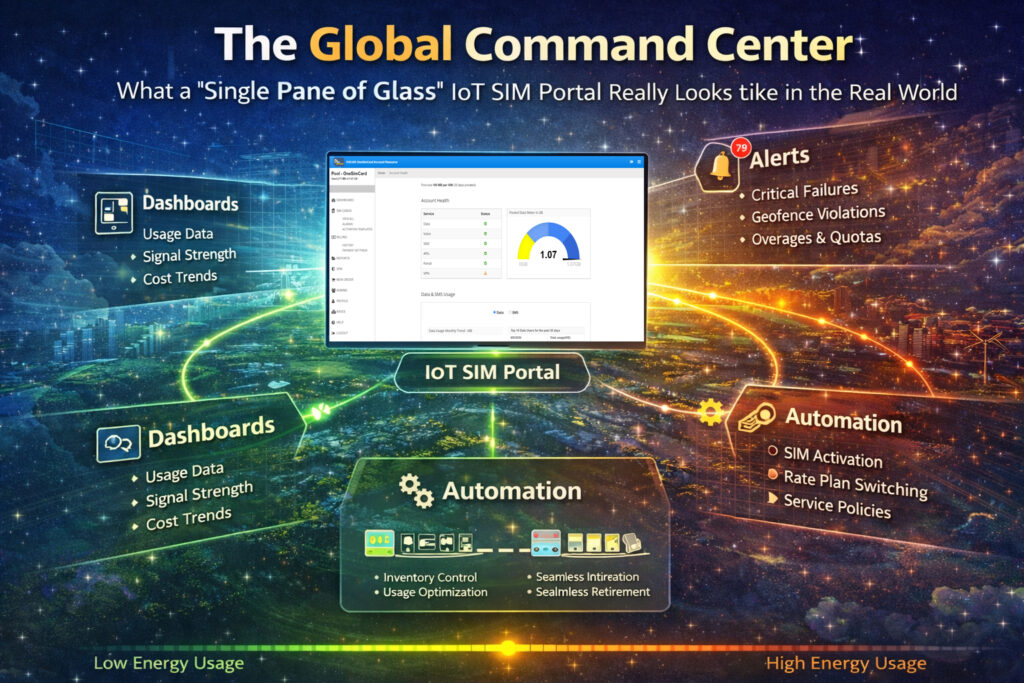
This is where the concept of a “single pane of glass” IoT SIM portal emerges. More than just a dashboard, it acts as a global command center, giving operators, engineers, and business teams a unified view of connectivity across the entire deployment. But what does this actually look like in the real world? Let’s walk through how modern IoT SIM management platforms function day to day.
The Dashboard: Your Network at a Glance
The first experience inside a true IoT command center is clarity.
A well-designed dashboard does not overwhelm users with raw data. Instead, it presents the health of the entire deployment in a visual snapshot. Operators can immediately see how many SIMs are active, suspended, or inactive. Maps display geographic distribution, highlighting where devices are currently connected and which networks they are using.
Key performance indicators typically include:
- Active SIM count and growth trends
- Data consumption by region or device group
- Network attachment status
- Session activity and connection success rates
- Alerts requiring attention
This overview transforms connectivity from a technical detail into an operational metric. Executives can track expansion, operations teams can monitor performance, and engineers can spot anomalies instantly.
Real-Time Visibility: Knowing What’s Happening Now
In IoT environments, problems rarely announce themselves politely. A device may suddenly consume excessive data, lose connectivity, or attach to an unexpected network.
Real-time monitoring tools allow teams to detect these changes immediately. Instead of waiting for billing surprises or customer complaints, operators can watch usage patterns as they happen.
Live session views often provide details such as:
- Current network operator
- Signal and registration status
- Active data sessions
- IP assignment and routing information
- Recent connection history
This level of visibility turns troubleshooting into investigation rather than guesswork.
Alerts: The Early Warning System
A global deployment cannot rely on humans constantly watching dashboards. Automation begins with intelligent alerts.
Modern IoT portals allow administrators to define thresholds and behaviors that trigger notifications. For example:
- Data usage exceeds expected limits
- A SIM connects outside an approved country
- A device goes offline for a defined period
- Rapid session retries indicate connectivity issues
Alerts can be routed via email, SMS, webhook, or integrated into monitoring platforms like Slack or enterprise incident systems. The goal is simple: surface issues before they become outages.
In practice, alerts become the nervous system of the command center, signaling when attention is required.
Automation: Scaling Without Adding Complexity
Manual management works for dozens of SIMs. It fails completely at scale.
Automation is what allows a single platform to manage massive deployments efficiently. Through rules and templates, organizations can define how SIMs behave throughout their lifecycle.
Examples include:
- Assigning devices to usage pools or billing groups
- Applying data limits or SMS limits policies
- Suspending SIMs after inactivity thresholds
- Locking SIMs to devices by tying it to a particular IMEI
Automation reduces human error and ensures consistent policies across regions and teams. It also enables lean operations, where small teams manage vast fleets of connected devices.
SIM Lifecycle Management: From Warehouse to Retirement
Every IoT SIM follows a lifecycle. A command center portal tracks this journey from beginning to end.
1. Inventory and Provisioning
SIMs begin as inventory assets. Teams can assign identifiers, nicknames, or device associations before deployment. Bulk provisioning tools prepare many SIMs simultaneously.
2. Activation
Activation may occur manually or automatically through API’s when a device is registered by your customer. Policies ensure correct configuration from the start.
3. Operational Monitoring
During active service, the portal monitors usage, connectivity health, and compliance with policies.
4. Optimization
Usage analytics help operators adjust plans, pools, or network preferences to improve efficiency and cost control.
5. Suspension or Decommissioning
When devices retire or projects end, SIMs can be suspended or permanently deactivated, preventing unauthorized usage.
Managing this lifecycle centrally eliminates fragmented workflows across spreadsheets and carrier portals.
Analytics: Turning Data into Insight
Beyond monitoring, command centers provide analytics that reveal patterns across deployments.
Operators can analyze trends such as:
- Seasonal usage changes
- Regional network performance differences
- Device firmware impact on connectivity
- Data consumption by application type
These insights help organizations move from reactive management to proactive optimization.
For example, identifying consistent signal issues in a region might lead to antenna redesigns or network preference adjustments.
API Integration: The Portal That Extends Everywhere
A true single pane of glass does not live in isolation. APIs allow the portal to integrate with enterprise systems, enabling automation beyond the interface itself.
Organizations often connect IoT platforms to:
- Device management systems
- Billing platforms
- CRM tools
- Logistics tracking software
- Security monitoring environments
Through APIs, SIM actions like activation, suspension, or usage queries can happen automatically as part of business workflows.
The portal becomes not just a dashboard, but an operational engine.
Security and Access Control
Large organizations require controlled access to sensitive systems. Modern IoT portals provide role-based permissions so different teams see only what they need.
Examples include:
- Finance teams viewing billing analytics
- Operations teams managing SIM status
- Developers accessing API credentials
- Regional managers monitoring local deployments
Audit logs record every action, creating accountability and simplifying compliance reporting.
The Human Experience Behind the Technology
Despite all the technology, the real success of a command center lies in usability.
Operators should be able to diagnose issues quickly, onboard new devices easily, and understand system behavior without deep telecom expertise. Clear design, intuitive navigation, and meaningful visualization turn complex infrastructure into manageable workflows.
In real deployments, the difference between a usable portal and a confusing one often determines operational efficiency.
From Visibility to Control
The phrase “single pane of glass” is sometimes misunderstood as simply viewing data in one place. In reality, the goal is unified control.
A true global command center allows organizations not only to observe connectivity but to shape it. Policies, automation, analytics, and lifecycle management work together to create a responsive system that adapts as deployments grow.
The Future Command Center
As IoT continues to evolve, command centers will incorporate AI-driven insights, predictive alerts, and automated optimization. Platforms will anticipate connectivity issues before they occur and recommend adjustments based on historical performance.
Connectivity management will shift from monitoring to orchestration.
The Final View
Behind every successful global IoT deployment is an invisible operations hub coordinating millions of connections. The single pane of glass is not just a convenience. It is the foundation that allows organizations to scale confidently.
When dashboards provide clarity, alerts provide awareness, and automation provides control, connectivity stops being a challenge and becomes a strategic advantage.
The global command center is where complexity becomes visibility and visibility becomes power.
OneSimCard IoT’s cloud based, proprietary OSCAR SIM Management Portal was designed internally to be powerful but simple to use. We give you all the functionality you need, but nothing you don’t to make it a clean and easy user experience. Our Pooled and Pay-As-You-Go (PAYG) portals include all the security, automation, and integration to make IoT SIM card deployments a breeze.