
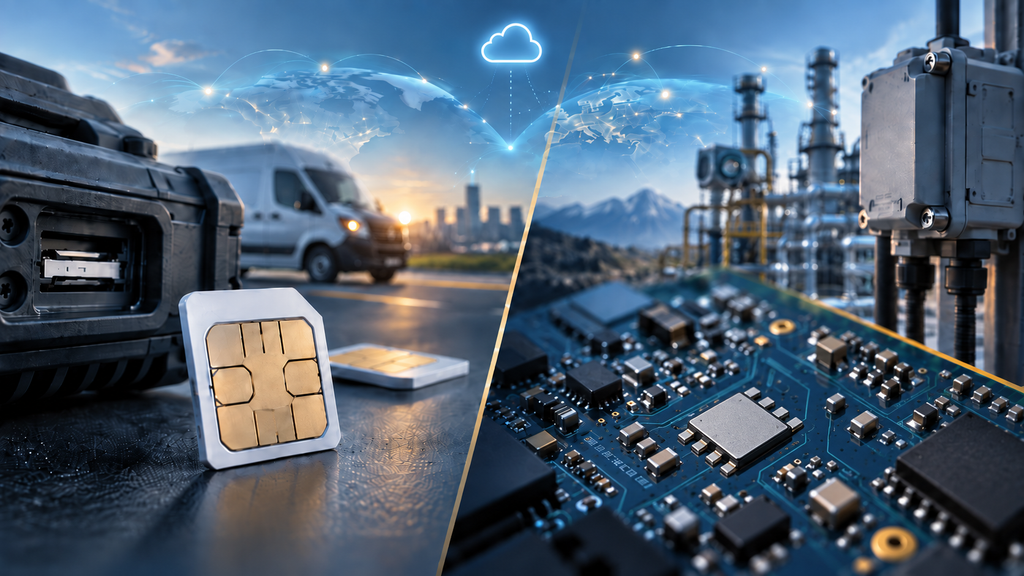
“eSIM or physical SIM?” is how the question usually gets asked—but it’s a muddled way to frame a hardware decision, because “eSIM” has become a catch-all that means different things to different people. Sometimes it means a soldered chip. Sometimes it means the ability to switch carriers over the air. Those are two separate things, and conflating them is how deployments end up with the wrong hardware.
So let’s reframe it cleanly. The actual physical choice is between a removable plastic SIM (the familiar card, in 2FF, 3FF, or 4FF sizes) and a soldered SIM (an MFF2 chip fixed to the board). Whether either one can switch carriers remotely is a separate capability—eUICC, or remote provisioning—that can ride on top of both form factors. Keep those two questions apart and the decision gets much simpler.
This is a decision framework, not a verdict. Weigh your deployment against four factors—form factor, remote provisioning, ruggedization, and lifecycle cost—and the right hardware usually becomes obvious.
First, a Quick Definition
Removable plastic SIM (2FF / 3FF / 4FF). The card you already know, in three shrinking sizes: 2FF (mini), 3FF (micro), and 4FF (nano). It drops into a tray or slot and can be pulled and swapped by hand.
Soldered SIM (MFF2). A small chip soldered directly onto the device’s circuit board. It’s permanent—no slot, no card to remove.
A note on “eSIM” and eUICC. What most people mean by “eSIM” is remote provisioning: the eUICC technology that lets a SIM download and switch carrier profiles over the air. Crucially, eUICC is not a form factor. An eUICC-capable SIM can be a soldered MFF2 chip or a removable plastic card. So “should it be soldered or removable?” and “should it support remote provisioning?” are two independent questions—and this article keeps them that way.
Factor 1: Form Factor
Where and how your device is built matters more than almost anything else.
Choose a soldered SIM (MFF2) when your device is sealed, compact, or exposed to vibration and shock. Fixed to the board, it can’t rattle loose, can’t be stolen, and takes up minimal space. This is why automotive telematics, industrial machinery, and wearables lean heavily on MFF2.
Choose a removable plastic SIM (2FF/3FF/4FF) when you need field-swappable connectivity, when the device is assembled by hand at lower volumes, or when someone may need to change SIMs on-site. A slot keeps your options open and simplifies repair. Among the plastic sizes, 4FF (nano) suits compact modern hardware, while 2FF (mini) still shows up in rugged industrial gear where a larger, easier-to-handle card is an advantage.
Quick test: if a technician will never realistically open the device again, solder it. If someone might need to change the SIM in the field, keep the slot.
Factor 2: Remote Provisioning
This is the factor most often mislabeled as “eSIM,” so be precise: the question here is whether you need eUICC remote provisioning—and it applies to plastic and soldered SIMs alike.
If you’re shipping devices across borders, a single fixed carrier profile forces a choice: pre-load one carrier and accept roaming, or physically install a local SIM in each destination. Neither scales across thousands of units. A eUICC-capable SIM—whether MFF2 or plastic—lets you provision the right profile over the air after deployment, and reprovision later if a carrier relationship changes or a network is sunset.
For a handful of devices in one country, remote provisioning is a nice-to-have. For a global fleet—or any deployment where devices ship before their destination is known—it can be the deciding capability.
That said, many plastic SIMs from a good provider (like OneSimCard IoT) already include multi-network roaming, which solves a large share of “our devices move around” problems without eUICC at all. If a roaming SIM covers your regions, you may not need remote provisioning—on either form factor.
Factor 3: Ruggedization and Environment
Environment can override every other consideration, and here the form factor itself is what matters.
Soldered MFF2 wins decisively in harsh conditions. With no slot, no exposed contacts to corrode, and no card to work loose, it tolerates extreme temperatures, moisture, dust, and constant vibration far better than a card in a tray. For vehicles, heavy equipment, outdoor enclosures, or anything shaken, soaked, or baked, a soldered SIM is a reliability upgrade, not just a convenience.
Removable plastic SIMs are perfectly reliable in controlled environments—indoors, climate-stable, low-vibration. But every slot is a potential point of failure and an entry point for the elements. If your device lives somewhere unforgiving, that matters.
There’s a security dimension too: a soldered SIM can’t be pulled out and dropped into another device, which reduces theft and SIM-swap fraud on unattended field assets. (Note: We always suggest using an IMEI lock to prevent misuse of removable SIMs).
Factor 4: Lifecycle Cost
Look past unit price to total cost over the device’s life.
Removable plastic SIMs usually have the lowest upfront cost and no added infrastructure. For short-lived devices, small fleets, or single-country deployments, they’re often the most economical choice. The hidden cost shows up only if you later need to swap carriers at scale—truck rolls and manual labor.
Soldered MFF2 costs a bit more to place on the board, and adding eUICC remote provisioning brings its own platform overhead. But for long-lived or widely distributed fleets, that combination can dramatically lower lifecycle cost. When a device runs for 5–10 years in a hard-to-reach spot, switching carriers remotely—no site visits, adapting to changing network availability, renegotiating connectivity without replacing hardware—often pays for itself many times over.
Rule of thumb: the longer a device lives and the harder it is to reach, the more a soldered, remotely provisionable SIM justifies its upfront premium.
Putting It Together
Run your deployment through the four factors and a pattern emerges—remembering that form factor and remote provisioning are separate choices:
– Lean soldered MFF2 if your devices are sealed, rugged, hard to reach, long-lived, or high-volume (MFF2 SIMs typically have a 500 MOQ).
– Lean removable plastic (2FF/3FF/4FF) if your devices are indoor, lower-volume, field-serviceable, short-lived, or single-region.
– Add eUICC remote provisioning—on whichever form factor you chose—if your devices cross borders, ship before their destination is known, or must outlive their original carrier deals. And if a multi-network roaming SIM already covers your regions, you may not need it at all.
Many real fleets mix all of this—soldered, eUICC-capable SIMs in the harsh, high-volume, long-life products, and simple plastic SIMs in the accessible, lower-volume ones. That’s not indecision; it’s matching the hardware to the job.
You don’t have to make the call alone. At OneSimCard IoT, plastic SIMs, soldered MFF2, and Multi-carrier support on all of our SIM cards are available. We also offer eUICC remote provisioning if needed for additional costs. You can pick the right form factor and capability per product line—and manage all of it from one place. Start from your deployment’s real constraints, weigh the four factors, and the SIM that fits will make itself clear.