
Managing cellular connectivity becomes increasingly complicated as an IoT deployment expands across networks, countries and device types. A connectivity solution that works well for a small domestic pilot may become difficult to manage when thousands of devices are operating around the world.
The GSMA’s SGP.32 specification was created to solve many of these challenges. It introduces an eUICC remote provisioning architecture designed specifically for IoT devices, including equipment with limited processing power, restricted network access or no user interface.
For IoT businesses, SGP.32 represents an important step toward more flexible, scalable and remotely manageable cellular connectivity.
What Is SGP.32?
SGP.32 is the GSMA technical specification for remotely provisioning and managing eSIM profiles in IoT devices. It works alongside SGP.31, which defines the overall architecture and requirements for the GSMA IoT eUICC ecosystem.
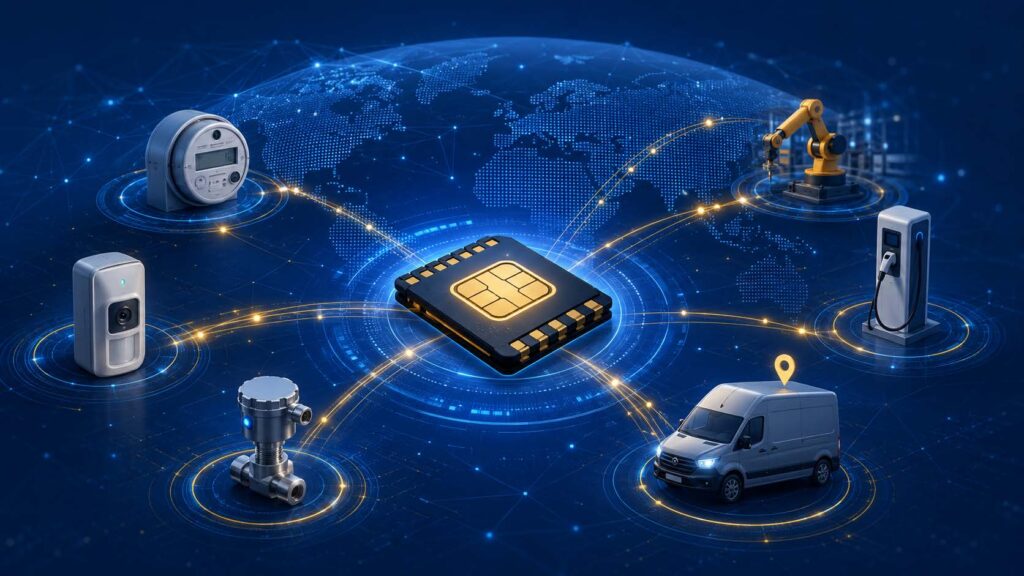
Unlike smartphones, many IoT devices do not have screens, keyboards, cameras or users available to scan QR codes and approve profile installations. Devices such as smart meters, GPS trackers, industrial sensors, EV charging stations and security systems may also operate with limited bandwidth or intermittent connectivity.
SGP.32 was designed around these realities. It enables cellular profiles to be securely downloaded, enabled, disabled and managed remotely without requiring someone to physically access the device. The latest active version, SGP.32 v1.3, was published by the GSMA in May 2026.
How SGP.32 Works
The SGP.32 architecture introduces several components that work together to manage connectivity.
The eUICC is the secure SIM hardware inside the device. It can store one or more mobile network operator profiles.
The IoT Profile Assistant, or IPA, handles profile-related communications within the IoT device. Depending on the implementation, the IPA may run in the device or within the eUICC itself.
The eUICC IoT Manager, known as the eIM, provides the remote management layer. It sends instructions that allow authorized systems to initiate profile downloads and perform lifecycle management operations.
An SM-DP+ platform securely prepares and delivers the operator profile that will be installed on the eUICC.
Together, these components make it possible to manage eUICC connectivity across large fleets without relying on a consumer-style interface or physically replacing SIM cards. The SGP.32 architecture specifically adds the eIM and IPA roles to simplify provisioning and lifecycle management for IoT deployments.
The Business Benefits of SGP.32
Remote network profile management
An organization can remotely download and manage cellular profiles after devices have been manufactured or deployed. This can reduce the need to determine every device’s final connectivity provider during production.
Fewer physical SIM replacements
Changing a traditional IoT SIM may require a technician, replacement hardware, shipping and sometimes access to equipment installed in remote or hazardous locations. SGP.32 can allow connectivity changes to be made remotely instead.
For a fleet containing thousands of devices, avoiding even a small number of service visits can produce meaningful savings.
Better support for global IoT deployments
A manufacturer may be able to produce a more standardized device configuration and then assign appropriate connectivity profiles according to the device’s destination or operating region.
This can simplify inventory management and reduce the need to manufacture separate product versions for every network or country.
Greater connectivity flexibility
Network coverage, commercial agreements and regulatory requirements may change during the life of an IoT device. SGP.32 provides a standardized way to adapt the connectivity profile without replacing the device.
This is especially valuable for long-life applications such as utility meters, industrial machinery, vehicles and infrastructure equipment that may remain deployed for ten years or longer.
More scalable lifecycle management
SGP.32 treats connectivity as something that can be managed throughout the device lifecycle rather than as a one-time factory decision. Profiles can be downloaded, listed, enabled, disabled or deleted through standardized processes.
SGP.32 Compared With SGP.02
SGP.02 was developed primarily for machine-to-machine applications and has supported many important connected-device deployments. However, its architecture generally involves more tightly controlled relationships between operators, subscription-management platforms and eSIM environments.
SGP.32 applies lessons from both the earlier M2M model and the consumer eSIM model. Its architecture is intended to create a more flexible IoT ecosystem while still accommodating devices that cannot perform consumer-style profile activation.
This does not mean every existing SGP.02 deployment must be immediately replaced. Many businesses will operate legacy SIMs, multi-IMSI SIMs and newer SGP.32 eSIMs side by side for years. The right approach will depend on device hardware, deployment duration, geographic requirements and the level of connectivity control the organization needs.
Challenges to Consider
SGP.32 is not a magic switch that automatically makes every IoT deployment carrier-independent.
Devices must include compatible eUICC hardware and an appropriate IPA implementation. The eIM, eUICC, profile delivery platform, device software and connectivity providers must also work together correctly.
Interoperability testing is therefore essential. The GSMA ecosystem has emphasized the importance of validating communication between the eIM, IPA and eUICC before large-scale commercial deployment.
Organizations must also plan how a new device receives its first connection. A bootstrap profile or another initial connectivity method may be required before additional profiles can be downloaded.
Other considerations include:
- Who is authorized to initiate a profile change
- How failed downloads or profile switches will be recovered
- Whether a fallback profile will be available
- How connectivity policies will be automated
- Which profiles are permitted in each country
- How existing devices will coexist with SGP.32 equipment
The technology provides the machinery, but businesses still need a clear driver’s manual.
Which IoT Applications Can Benefit?
SGP.32 can be particularly valuable for devices that are deployed internationally, remain in service for many years or are expensive to physically access.
Potential applications include connected vehicles, GPS tracking systems, EV charging stations, smart meters, medical devices, alarms, industrial equipment, digital signage, agricultural sensors and remote monitoring systems.
It may also benefit manufacturers that do not know where a device will ultimately be deployed when it leaves the production line.
Preparing for SGP.32
Businesses evaluating SGP.32 should begin by reviewing their entire connectivity lifecycle, from manufacturing and initial activation through ongoing management and eventual device retirement.
Important questions include whether the modem, module and eUICC support SGP.32; where the IPA will operate; who will provide the eIM; how bootstrap connectivity will work; and whether the solution has been tested across the required networks and regions.
SGP.32 changes the IoT SIM from a fixed connectivity component into a remotely manageable part of the device architecture. For companies deploying connected equipment globally, that flexibility can reduce operational friction, strengthen network resilience and make it easier to adapt as coverage and business requirements evolve.
The result is not simply a new type of eSIM. It is a more programmable foundation for global IoT connectivity.
OneSimCard IoT recently launched support for SGP.32 on specialized eUICC SIM cards. Contact our experts if you would like to learn more.