
Every connected device needs a way to reach the internet, and for most IoT deployments the choice comes down to two options: a cellular IoT SIM card or WiFi. Both will get your device online. But they behave very differently once that device leaves the lab and goes into the real world—across a warehouse floor, a fleet of vehicles, a remote pump station, or a customer’s home in another country.
Choosing the wrong connectivity method is one of the most common and most expensive mistakes in an IoT project. A sensor that drops offline every time someone changes a router password, or a tracker that only works inside one building, quickly turns a promising deployment into a support headache. Here’s a clear look at how IoT SIM cards and WiFi compare, and where each one makes sense.
What’s the difference?
A WiFi connection relies on a local wireless network. Your device connects to a nearby router or access point, which is in turn wired into a broadband internet connection. The device is only online when it’s within range of a network it has been configured to join.
An IoT SIM card connects your device to a cellular network—the same infrastructure that powers mobile phones—but on a plan built for machines rather than people. Instead of depending on a specific router, the device connects wherever there is mobile coverage. Many IoT SIMs are also multi-network, meaning they can roam across several carriers to find the strongest available signal. The best IoT SIM cards are no steering SIMs that allow the device to decide what network to use in a given geographic location, at a given time.
The case for WiFi
WiFi is familiar, widely available, and often already installed wherever people work and live.
Pros of WiFi:
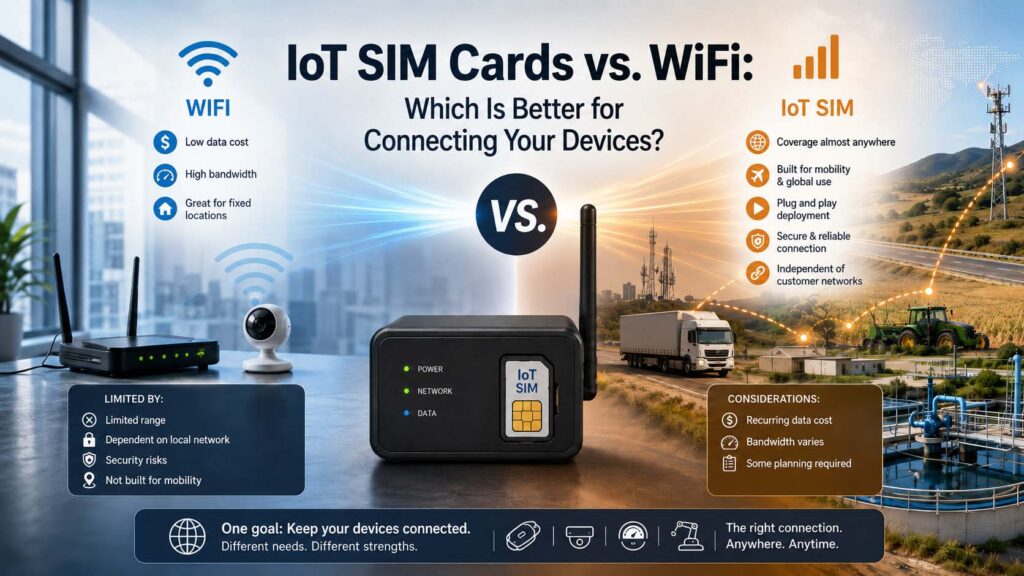
- Low or no recurring data cost. Once the broadband connection is paid for, adding another device usually costs nothing extra in data fees. For high-bandwidth applications like video, this is a major advantage.
- High bandwidth. WiFi comfortably handles large data volumes—HD cameras, firmware pushes, and rich sensor streams—without the throughput limits or per-megabyte pricing common on cellular plans.
- Ubiquitous hardware. WiFi chips are inexpensive and built into almost everything, which keeps device costs down.
- Simple in a fixed, controlled location. If your device lives in one place with a stable, well-managed network, WiFi can be perfectly reliable.
Cons of WiFi:
- Range is limited. Coverage stops at the edge of the signal. Move the device to a far corner of the building, a basement, or an outdoor yard, and the connection degrades or disappears.
- You don’t control the network. In homes and third-party sites, someone can change the password, swap the router, or reconfigure security settings—and your device silently goes offline. Onboarding a device onto an unfamiliar WiFi network is also notoriously fiddly for non-technical users.
- Security concerns. Shared and public WiFi networks are a well-known attack surface. Securing a fleet of devices across many uncontrolled networks is difficult.
- Not built for mobility. A device that moves—between buildings, cities, or countries—can’t stay attached to a single local network.
The case for IoT SIM cards
Cellular connectivity trades a small ongoing cost for independence from local infrastructure.
Pros of IoT SIM cards:
- Coverage almost anywhere. If there’s mobile signal, the device is online—no local router required. This is what makes cellular the default for tracking, fleet, agriculture, and remote-monitoring applications.
- Built for mobility and global deployment. A multi-network IoT SIM can roam across carriers and across borders, so the same device works whether it ships to one warehouse or to customers in 200+ countries.
- Plug-and-play deployment. There’s no network to join and no password to enter. Power the device on and it connects—which dramatically reduces installation time and support tickets, especially for devices sent to end customers.
- Stronger, more consistent security. Cellular traffic runs over the carrier’s private, encrypted network rather than a shared local one, and many IoT SIM platforms add private APNs, fixed IPs, and centralized management.
- Independent of the customer’s setup. The connection doesn’t break when someone changes their router or moves the device.
Cons of IoT SIM cards:
- Recurring data cost. You pay for the data you use. For low-bandwidth telemetry this is trivial; for constant high-definition video it can add up, so plan sizing matters.
- Bandwidth and coverage vary. Cellular throughput is lower than a good WiFi connection, and deep-indoor or truly remote locations may have weak signal—though multi-network SIMs and technologies like LTE-M and NB-IoT help considerably.
- A bit more upfront planning. You’ll want to match the SIM plan, network technology, and data allowance to your use case rather than simply joining an existing network.
How to decide
The right choice usually comes down to three questions:
- Does the device move, or go to locations you don’t control? If yes, a cellular IoT SIM is almost always the better fit. Trackers, vehicles, vending machines, medical devices, and any product shipped to customers benefit from connectivity that doesn’t depend on someone else’s WiFi.
- How much data does it send? Sensors, meters, alarms, and controllers send small bursts of data and are ideal for cellular. Bandwidth-heavy applications like continuous video streaming in a fixed location often lean toward WiFi—or a hybrid setup.
- Who installs and maintains it? If a non-technical person has to get the device online, cellular’s plug-and-play nature removes a huge amount of friction and support cost.
For many deployments, the two aren’t mutually exclusive. A common pattern is WiFi as the primary connection with a cellular IoT SIM as automatic failover, so a device stays online even when the local network goes down.
The bottom line
WiFi shines when a device is stationary, sits on a network you control, and needs high bandwidth at low cost. IoT SIM cards shine when devices move, deploy across many locations or countries, need to work out of the box, or simply can’t afford to depend on someone else’s network.
For products that need to just work—anywhere, for anyone, without a setup wizard—cellular connectivity through an IoT SIM has become the practical default. And with multi-network SIMs that roam across carriers and borders, a single connectivity solution can now follow your devices wherever they go.