
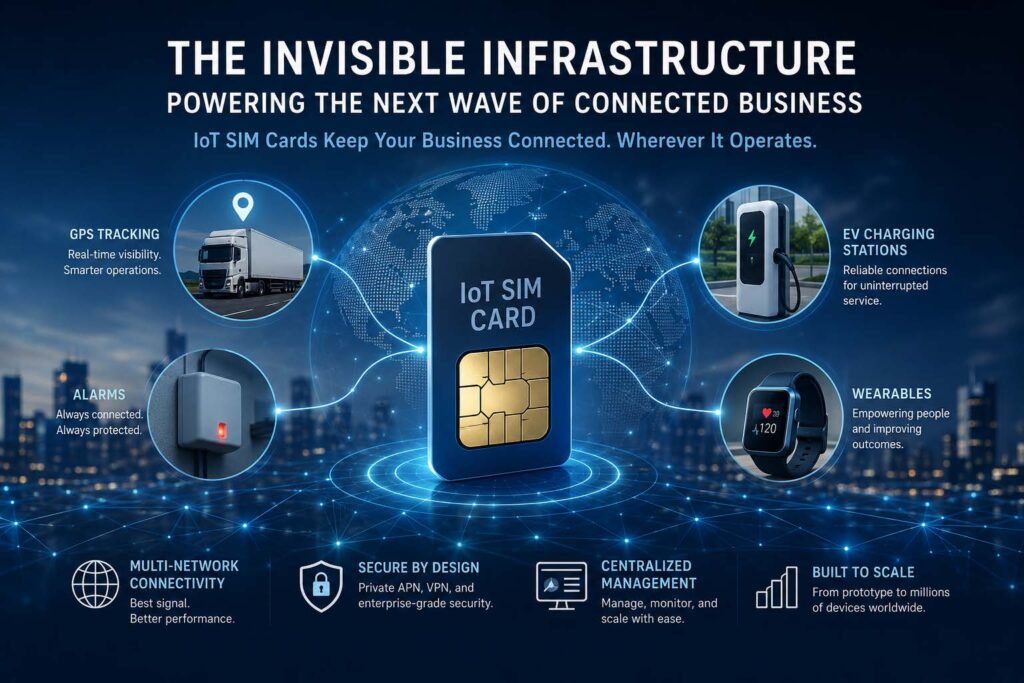
When business leaders discuss digital transformation, conversations often focus on artificial intelligence, cloud computing, cybersecurity, and analytics. Yet behind many of today’s most successful connected solutions lies a less visible technology that rarely receives the attention it deserves: the IoT SIM card.
As organizations deploy increasingly sophisticated Internet of Things (IoT) solutions, reliable connectivity has become a strategic business requirement rather than a technical afterthought. Whether managing fleets of vehicles, operating EV charging stations, monitoring security alarms, or enabling wearable devices, the ability to securely connect devices across diverse geographic regions can determine the success or failure of an IoT initiative.
The reality is simple: a connected device that cannot reliably communicate is no longer intelligent. It becomes just another piece of hardware.
Connectivity Is Now A Business Challenge
The early stages of IoT adoption often focused on proof-of-concept deployments. Organizations connected a handful of devices, gathered data, and demonstrated value. Today, many businesses are scaling from dozens of connected endpoints to thousands or even hundreds of thousands.
This growth introduces a new set of challenges.
Devices move across cities, states, and international borders. Network conditions change. Carriers differ by region. Security concerns increase. Operational visibility becomes more difficult.
The result is that connectivity itself becomes a strategic layer of the IoT ecosystem.
An IoT SIM card serves as the bridge between physical assets and digital systems, allowing devices to securely transmit data regardless of location. Modern IoT deployments increasingly depend on multi-network connectivity options that enable devices to access the strongest available network rather than relying on a single carrier.
For business decision makers, this translates into higher uptime, fewer service interruptions, and a better return on technology investments.
GPS Tracking Depends On Reliable Connectivity
GPS tracking has become a foundational technology across industries including transportation, logistics, construction, agriculture, and asset management.
While GPS determines a device’s location, connectivity is what allows that information to reach the organizations that depend on it.
A vehicle tracker that cannot transmit location updates loses much of its value. The same applies to high-value asset trackers, cold-chain monitoring devices, and equipment deployed in remote locations.
As businesses expand operations across wider geographic areas, network redundancy becomes increasingly important. Devices may travel through regions where one carrier performs well while another experiences congestion or coverage limitations.
Organizations deploying large-scale GPS tracking systems are increasingly prioritizing connectivity solutions that provide access to multiple networks and centralized management capabilities. This approach helps ensure continuous visibility into critical assets while reducing operational risk.
EV Charging Stations Require Always-On Communications
The rapid expansion of electric vehicle infrastructure presents another example of why connectivity matters.
Modern EV charging stations are more than power delivery systems. They are connected endpoints that process transactions, authenticate users, monitor equipment status, manage energy consumption, and report operational data in real time.
A charging station that loses connectivity may impact customer experiences, payment processing, maintenance visibility, and remote management capabilities.
As governments and private organizations invest billions into EV infrastructure, uptime expectations continue to rise. Operators increasingly recognize that connectivity must be treated as a core component of the charging ecosystem rather than an auxiliary service.
IoT SIM card technology enables charging networks to remain connected across urban environments, highways, parking facilities, and remote locations where traditional wired connections may be impractical or cost-prohibitive.
Security Systems Are Becoming More Intelligent
Traditional alarm systems primarily served as notification tools. Today’s connected security platforms function as intelligent monitoring ecosystems.
Modern alarms often incorporate sensors, cameras, environmental monitoring, access control systems, and cloud-based analytics. These systems generate valuable operational data that can improve security, safety, and business continuity.
However, these benefits depend on dependable communications.
Businesses increasingly expect security devices to provide real-time alerts, remote diagnostics, automated reporting, and continuous monitoring. Connectivity failures can create blind spots that reduce system effectiveness.
For organizations managing distributed facilities, retail locations, warehouses, or critical infrastructure, resilient connectivity has become an essential component of risk management strategies.
Wearables Are Expanding Beyond Consumer Applications
Wearable technology is evolving rapidly beyond fitness trackers and consumer electronics.
Industries including healthcare, manufacturing, logistics, and workplace safety are deploying wearable devices to improve operational efficiency and employee well-being.
Connected wearables can monitor worker safety, track environmental conditions, support lone-worker protection programs, and provide real-time communications in challenging environments.
As these deployments scale, organizations face many of the same connectivity challenges seen in other IoT sectors. Devices must remain connected while employees move between facilities, geographic regions, and network environments.
Reliable IoT connectivity allows businesses to capture valuable data while supporting real-time decision making and operational awareness.
The Future Of IoT Depends On Connectivity Strategy
The next phase of IoT growth will not be defined solely by smarter devices. It will be defined by smarter connectivity strategies.
Business leaders evaluating IoT investments should view connectivity as a strategic business asset rather than a procurement decision based solely on cost.
The organizations achieving the greatest value from IoT are increasingly those that prioritize reliability, scalability, security, and operational visibility from the beginning of their deployments.
Whether supporting GPS tracking platforms, EV charging stations, alarm systems, wearable technology, Ag Tech, or any emerging connected solutions, the underlying connectivity layer plays a critical role in determining outcomes.
As IoT continues to expand across nearly every industry, the humble IoT SIM card may remain largely invisible to end users. Yet for the businesses building the connected future, it is becoming one of the most important technologies in the entire digital ecosystem..
OneSimCard IoT is a leading supplier of IoT SIM card connectivity. With over 30 years in telecoms, OneSimCard IoT helps many organizations across many industries connect their remote devices in 200+ countries and territories. OneSimCard IoT’s SIM Cards feature Multi-Network, no-steering technology with a single APN and managed in a single pane of glass in all of the areas they cover. For more information contact their IoT experts.